The year 2026 will witness companies gathering a vast amount of data from multiple data sources. The data collected from data sources are raw data that are not useful, until it is converted into actionable insights.
Did you know, as per Statista's 2025 prediction, the global data generation will triple by 2029?
Therefore, there will be an upsurge in the demand for highly skilled data science professionals who help companies convert raw data into actionable insights that strengthen data-driven decision-making.
Let’s first explore the most common myths about data science and debunk them to clear all your doubts.
Unmasking Common Misconceptions in Data Science
A lot of myths about data science have developed over time. These misunderstandings can demotivate individuals who would want to excel in data science careers. Let’s debunk them with reality.
Myth 1: You need a PhD or must be a “genius” to succeed in Data Science
Most are convinced that data science is only for those with higher educational qualification or post-graduate level degrees or brilliant mathematical skills.
But the reality is that skills matter more than higher degrees. For instance, data science requires strong foundational knowledge, and good statistics and analytical reasoning are useful; you don’t always need to be a strong mathematician or a PhD holder to work as a data science professional.
Myth 2: Data science is all about coding
Yes — The job does involve coding (Python, R, SQL, etc.). But it’s not the entire story. A skilled data professional must possess domain knowledge, business intelligence, the ability to communicate, and the skill to interpret and present data clearly.
Usually, more time is put into cleaning the data, looking for patterns, and sharing findings than writing sophisticated code.
Myth 3: AI and automation will replace data scientists
With the rise of AI and automation, a lot of individuals worry about whether data scientists will ever be replaced by AI. But automation is no substitute for human judgment; it is a supplement to it. Machines can do the number crunching, but only humans can ask the right questions, set goals, make sense of results, and decide how to fit it all into an ethical framework.
For instance, cleaning data, training, testing features, and validating the model still need human supervision.
Myth 4: Bigger data always means better results
It is easy to assume that more data is always better. But that’s a myth. What really matters is the quality and relevance of data. Noisy, inconsistent, or irrelevant data can mislead analysis, often more than help it.
Sometimes simpler models applied to clean, relevant datasets outperform complex AI models applied to messy bulk data.
Myth 5: Data science is only for big tech companies
Some believe that data science roles can only be found in the tech giants. The reality is that every industry today is data-driven. Healthcare, finance, retail, manufacturing, energy, and even local businesses and small-to-midsize enterprises depend more and more on data for decision-making.
Whether you work as a data science professional in a start-up or even a government agency, there are meaningful tasks for you to do if you have the right Data science skills.
High-Paying Data Science Jobs and Salaries for 2026
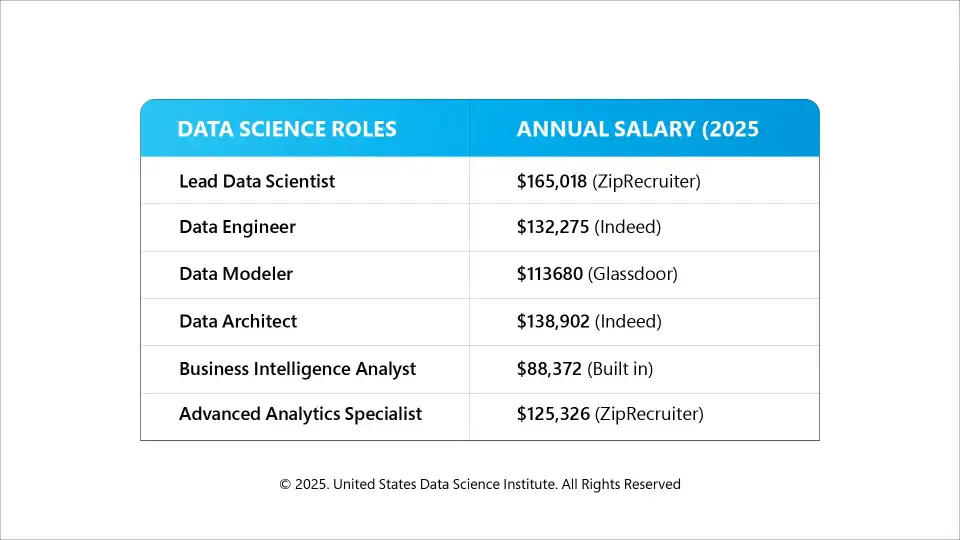
If you opt to go into data science, there are varied career options — each having its own focus, skill set, and future possibilities. The following are some of the most in-demand roles, as well as their salaries:
Check out our latest blog on Next Era of Data Science: Skills, Trends, and Opportunities to gain insights on the emerging Data Science jobs, such as AI Data Scientist, and more!
Today, companies appreciate skilled data professionals who not only know data science but also have domain expertise, the ability to communicate well, and can deliver insights that lead to actionable changes.
Although data science professionals' salaries and pay scales differ by sector and experience, long-term growth is positive. A career in Data science is worth it only if you have acquired the right skills.
Therefore, let’s explore the top data science certifications that can help you upskill in the right data science skills to future-proof your career.
How Can You Boost Your Data Science Career with USDSI®?
If you’re ready to transform from curious learner to capable practitioner, the USDSI® Data Science Certification offers a globally recognized, platform agnostic (vendor-neutral) Data Science certification:
These top data science certifications equip you with the right skills, hands-on exposure to Big Data, Data Analytics, AI, and Machine Learning techniques, and real-world problem-solving skills — helping you level up your Data science career and meet your goal to become skilled in Data Science. Enroll now!
Frequently Asked Questions
1. Is data science a good career for 2026?
Yes, data science is a strong career option for any fresher because companies need skilled data professionals who have acquired relevant data science skills and a globally recognized data science certification like USDSI®’s Data Science certifications.
2. Is math needed for data science?
You need basic knowledge of statistics, probability, and linear algebra to understand the patterns, build robust data models, and work as a data science professional.
3. Are data science jobs easy to get?
It cannot be said that data science jobs are “easy,” but they are accessible if you build the right skills through credible data science certifications that add validation and weight to your portfolio.
4. Can AI replace data scientists in 2026?
No, AI is simply automating the repetitive data science tasks so that data scientists can focus on more strategic and important tasks that require human supervision.
5. Is Python necessary for a data science job?
Python is crucial in data science because it supports analytics and AI, but skilled data professionals also upskill in SQL and R to stay competitive.
This website uses cookies to enhance website functionalities and improve your online experience. By clicking Accept or continue browsing this website, you agree to our use of cookies as outlined in our privacy policy.