Robotics has reached a new level, where intelligence is no longer concentrated in the cloud, but rather at the machine's own level. The requirement of real-time decision making, reliability, and autonomy has become imperative as robots assume more advanced roles in the various industries.
This is the place where Edge AI and TinyML are changing robotics, allowing robots to feel, reason, and act on the location of the information in real-time. Precedence Research estimates that the global Edge AI market will reach USD 31.05 billion by 2026, driven by the need for smart and low-latency systems.
This blog will discuss how Edge AI and TinyML are making the AI revolution in robotics, how the two technologies are changing the way robots are used today, and what the future of robotics looks like in the industrial, healthcare, and service sectors.
What Is Edge AI and Its Role in Robotics?
Edge AI is an approach that enables robots to execute intelligence on-unit, where information is produced, rather than using cloud servers. This makes it possible to sense and act on decisions in real time, which is crucial to autonomous systems.
In contrast to cloud-based applications, where latency, connectivity, and security issues arise, at the edge, AI processes the data locally to respond faster and be more reliable. Consequently, the robots get more autonomous, efficient, and competent, contributing to the speedy development of an AI-powered future of robotics.
What Is TinyML, and How Does It Complement Edge AI?
Tiny machine learning is a machine learning model that can execute on hardware with limited resources, typically with only kilobytes of memory and little processing power. Imagine it is a mini-miniature AI.
Combined with Edge AI, TinyML allows robots to act with efficient and intelligent behavior without the use of powerful processors or data pipelines. This enables AI in low-cost, low-power robots and allows it to be used extensively in industries.
Essentially, TinyML enables robots to learn from the environment and decide locally, and is part of their contribution to a faster response and more adaptive autonomy.
How Are Edge AI and TinyML Changing the Future of Robotics?
1. Faster Decision-Making
The use of Edge AI and TinyML causes robots to operate more quickly, taking decisions in real time by processing data on the device, allowing it to react instantly, ensuring safety in its approach, and making decisions more quickly, such as warehouse robots avoiding collisions in the real world without delays to the cloud.
2. Reduced Latency and improved Reliability
Robotics has always been constrained by latency, but Edge AI provides on-device intelligence to respond faster and more reliably, particularly in low- or no-connectivity conditions such as mines and remote locations.
3. Smarter, Adaptive Behavior
Small ML models can be trained to observe progressive patterns of sensory data so that robots can adapt to environmental shifts. This gives rise to more organic and reactive behaviors.
For example, hospitality service robots will be able to learn patterns of the guests over time and enhance the quality of interaction without the need to be supervised by a human.
4. Better Privacy and Data Security
Numerous robotics uses are dealing with sensitive information, including video feeds and personal interaction. Computing data at the edge decreases network exposure and reduces the chances of interception, and therefore, as robots move into the public and personal space, the privacy and security of the project become more significant.
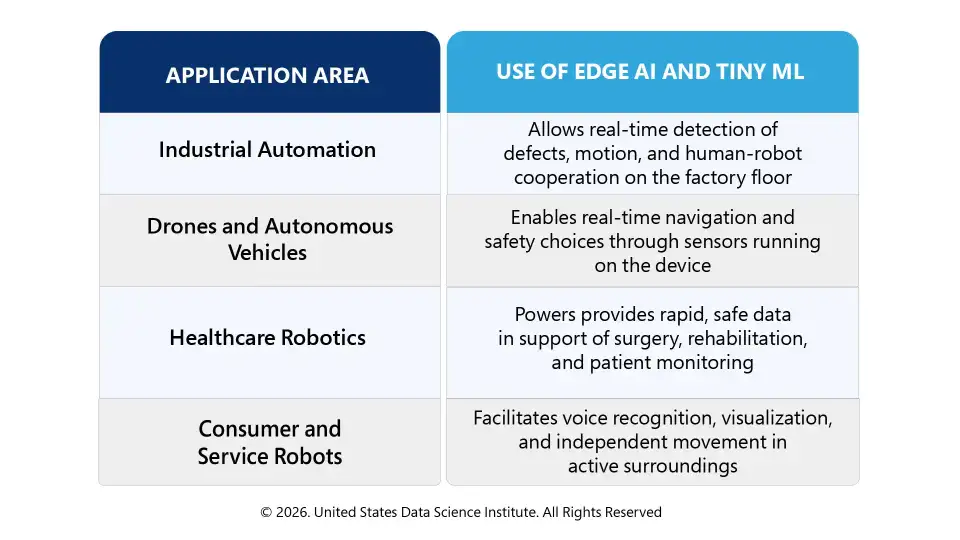
What Are the Popular Use Cases for Edge AI and TinyML?
These technologies are already finding real-world use across multiple domains
What Are the Challenges Faced by Edge AI and TinyML?
There are scaling challenges to these technologies despite the massive potential:
Edge AI and TinyML are designed to run on low-end hardware. A compromise between performance, power consumption, memory footprint, and the complexity of the model is still an engineering issue.
The process of training advanced AI models usually involves intense data centers; however, there is still a need to consider solutions to update the models on edge devices. Such techniques as federated learning or over-the-air updates are useful, but they make the process more complex.
The building, deploying, and managing of TinyML models on heterogeneous robotic hardware ecosystems is still in its early stages. The adoption will be quickened with better tools and standards.
How Can Businesses Prepare for the AI-Driven Future of Robotics?
With robotics in the future, businesses that embrace the use of Edge AI and TinyML early will be competitive. The following are 3 simple steps to follow:
STEP 1- Identify Key Use Cases
Begin with applications in which real-time independence, information protection, and robustness to connection problems are important.
STEP 2- Invest in Skill Development
The teams require skills in embedded systems, machine learning optimization, and AI hardware acceleration.
STEP 3- Take Advantage of Scalable Platforms
Focus on research architectures that assist cross-platform TinyML execution and Edge AI lifecycle control.
Organizations can use smarter systems of robots that are not only automated but also perceptive and adaptive by planning.
Way Forward
With emerging trends in robotics towards more autonomy, the central focus will be on the systems intelligence that are deployed, managed, and designed at the edge. Edge AI and TinyML are defining a new era of expectations in the field of data-driven decision-making, where next-generation robotic systems can become a core competency.
In order to remain updated on this change, professionals must apply skills in data science and applied AI, as opposed to theoretical knowledge. These future-ready skills can be developed by industry-aligned learning programs like the data science certifications provided by the United States Data Science Institute USDSI® enabling individuals and organizations to actively shape the evolving robotics ecosystem rather than simply react to it.
FAQs
Q. Are Edge AI and TinyML substitutes for cloud computing in robotics?
A. No. They decrease reliance on the cloud to do real-time work, but the cloud platforms are still deployed to perform large-scale training, analytics, and system-level updates.
Q. Which are the abilities needed to work with Edge AI and TinyML in robotics?
A. The professionals should have a combination of embedded systems expertise, machine learning optimization, and an ability in data science that is geared towards real-world conditions that are resource-constrained.
Q. What kind of sensors can rely on Edge AI in robotics?
A. Vision, audio, motion, and environmental sensors, because the interpretation of high-frequency sensor data can be accomplished in a real-time manner with Edge AI.
This website uses cookies to enhance website functionalities and improve your online experience. By clicking Accept or continue browsing this website, you agree to our use of cookies as outlined in our privacy policy.