
Every major business decision in 2026 is, at some level, a data decision. Pricing, hiring, market expansion, and risk all run through systems, models, and outputs that someone at the top needs to be able to read. Most executives trust their data teams and far fewer can engage with data directly.
According to Gartner's March 2026 Data & Analytics Predictions, 60% of organizations that successfully differentiate through AI by 2030 will be led by executives who prioritize data fluency as a core leadership capability. The gap between trusting data and understanding data is exactly where leadership loses ground.
What Data Literacy Means for C-Suite Leaders
Data literacy for executives is not about writing code or building dashboards. It is the ability to read analytical outputs critically, recognize when data has been shaped to tell a particular story, and make decisions with confidence.
Most organizations still treat data literacy skills as something that belongs in the analyst function. But decisions made at the C-suite level need the same scrutiny. Without it, even the best data infrastructure produces outputs that nobody upstairs can properly evaluate.
Where Does the Executive Data Gap Shows Up
When data fluency is absent at the leadership level, the consequences compound across strategy, operations, and culture.
The most common breakdowns include:
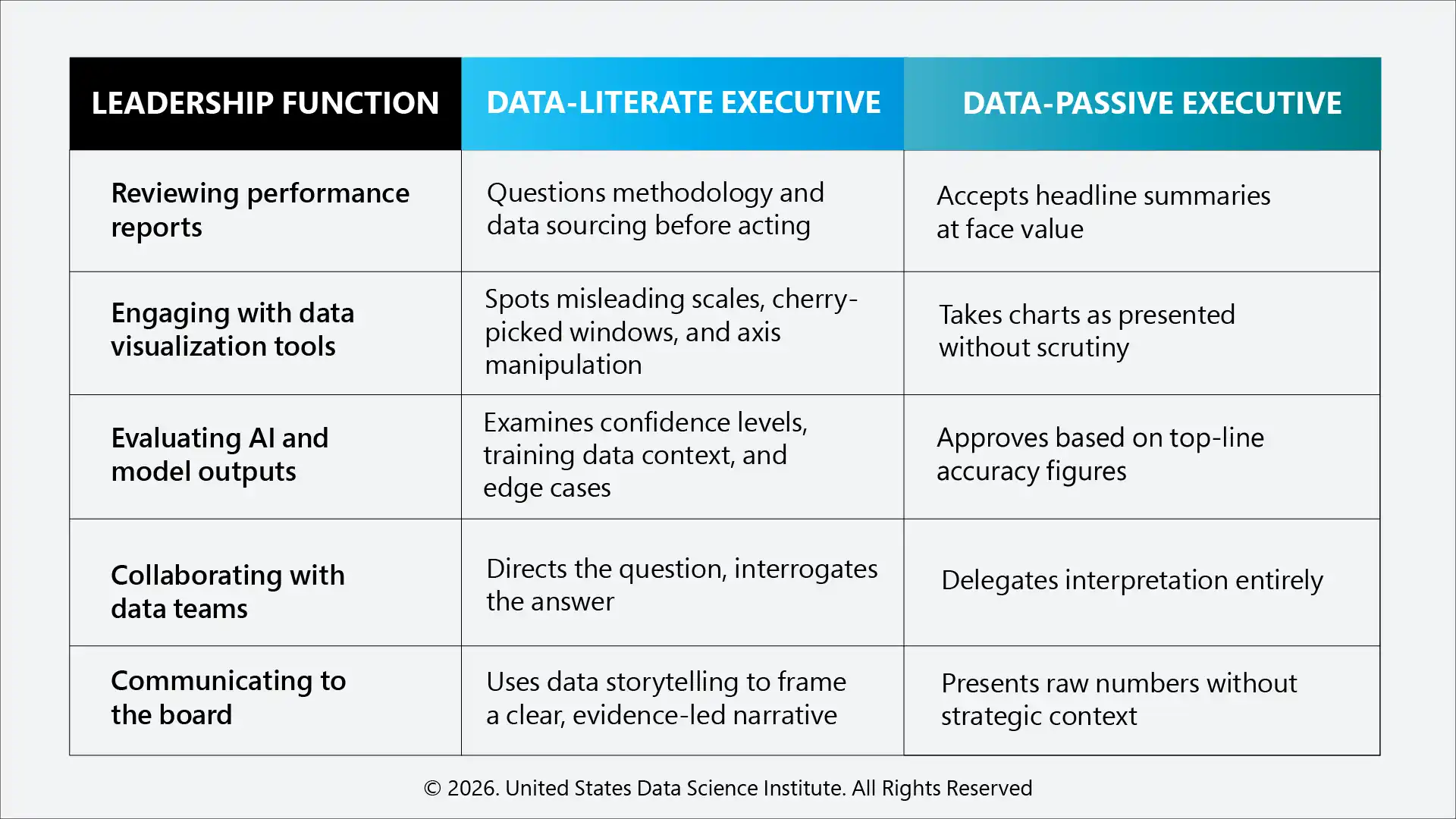
The table below shows how this plays out across core executive functions.
Table: Data-Literate vs. Data-Passive Executive Behavior Across Core Functions
The executives in the left column are not practitioners. They are fluent, and that fluency changes every decision downstream.
Is the Current Technology Landscape Making Data Literacy a Board-Level a Concern
The pressure on C-suite data fluency is not new. What has changed is the scale and speed at which data-driven systems now operate inside organizations.
Machine learning integration across tools like Salesforce Einstein, Microsoft Azure ML, and Google Vertex AI means these systems are no longer advisory. They are operational, influencing pricing, hiring, and forecasting in real time, often without a human checkpoint between the model output and business action.
Without the data science skills to engage critically, executives cannot:
Beyond AI, platforms like Tableau, Power BI, and Looker have made data more visually accessible, but also easier to present selectively.
As per USAII® Insight on "AI Leadership Trends 2026: What Executives Need to Know" As AI spending doubles in 2026, most C-suite leaders are signing off on data-driven strategies they cannot independently evaluate, making data literacy the missing link between AI investment and AI governance.
What Data Literacy at the C-Suite Level Actually Looks Like in Practice
Executive data literacy is not a single skill. It is a set of applied competencies that collectively shift how a leader engages with evidence.
For C-suite leaders, developing meaningful data literacy skills means being able to:
These are not advanced technical skills. They are executive-level habits, and they are entirely learnable with the right structure.
Build Data Fluency Through the Right Upskilling
The majority of executive upskilling programs in this space miss the mark in one of two directions; either too technically deep to be practically useful at leadership level, or too surface-level to produce any real change in how decisions get made.
The Certified Senior Data Scientist (CSDS™) from the United States Data Science Institute (USDSI®) is specifically designed for professionals operating at the intersection of data science skills and strategic leadership.
It bridges the gap that most programs overlook, building the depth needed to engage critically with data systems, AI outputs, and analytics functions, without requiring executives to cross into technical practitioner territory. For C-suite leaders overseeing data-dependent strategy or AI-driven operations, it is one of the most relevant credentials available at this level.
The Way Forward
The organizations pulling ahead in 2026 are not just adding more data; they are led by people who can engage with it directly and critically.
Three priorities define the path forward for C-suite leaders:
In a digital-first economy, data literacy is not an add-on to strong leadership. It is the foundation of it.
FAQs
Does building C-suite data literacy reduce the organization's dependency on large data teams?
Building C-Suite data litercay sharpens the way leadership collaborates with data teams by enabling executives to ask more precise, better-directed questions.
What do data-focused C-suite executives earn in the USA in 2026?
According to Glassdoor, Chief Data Officers in the USA reach top salaries of $432,787 annually, Chief Digital Officers average $328,502 per year, and top earners exceed $601,158.
How do C-suite professionals maintain their USDSI® Certified Senior Data Scientist (CSDS™) credential?
The USDSI® CSDS™ certification is valid for three years and can be renewed six months before expiry for USD 249 via the USDSI® myControlPanel dashboard, keeping your credential aligned with the latest data science frameworks.
This website uses cookies to enhance website functionalities and improve your online experience. By clicking Accept or continue browsing this website, you agree to our use of cookies as outlined in our privacy policy.