
Consider this: two companies sell the same product, at the same price, to the same customer. One grows, but the other struggles. The difference? One knows how to leverage data to know what customers want, and which decisions will make a difference. While the other remains stuck, making guesses.
This gap is growing as digital competition escalates. A proper Data & Analytics Strategy helps you swap assumptions with clarity and make decisions based on evidence rather than opinions.
In this blog, you’ll learn how to build a powerful and robust Data & Analytics Strategy that turns data into measurable business value in 2026.
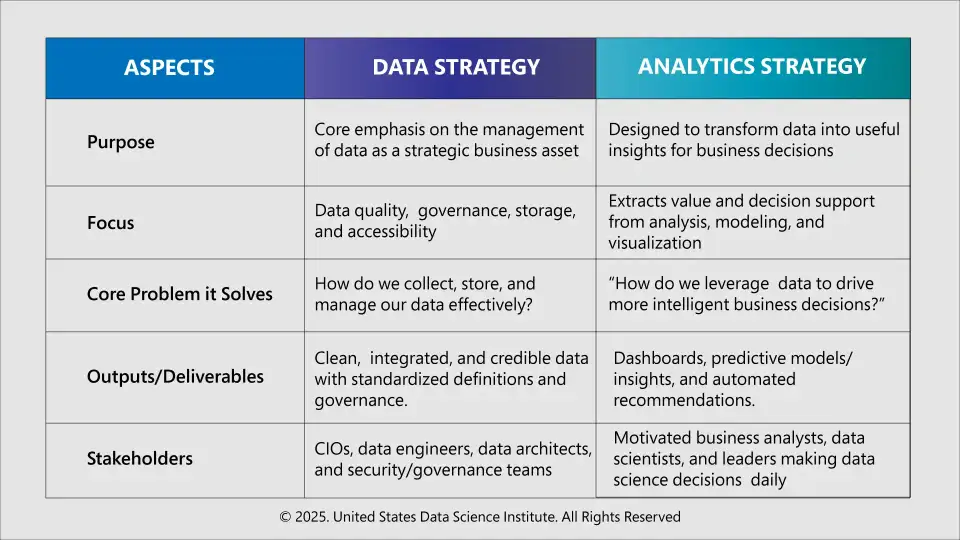
Data Strategy vs Analytics Strategy
Here are some key aspects that differentiate data and analytics strategy. Explore them to get a clear understanding of them before building them:
How to Build a Data & Analytics Strategy in 2026?
A modern data & analytics strategy isn't talking about technology anymore. It is the business architecture detailing how data will create value, improve your decision-making, and enhance your competitive standing.
Having a clear data & analytics strategy means that you do not have to guess or second-guess what you should do and make your decisions with absolute confidence.
Here are the key foundations you’ll use to craft a data & analytics strategy that drives business value in 2026.
1. Start With Business Value, Not with Data Assets
Most organizations start by cataloguing datasets, selecting tools, or getting new dashboards in place. But this method results in complexity with no clarity.” Always begin with the business value you’re trying to deliver.
Three key questions as per the Gartner study, 2025 (Roadmap Drive Successful, Business Outcomes with Data, Analytics and AI):
When you establish clear business objectives, you enable data science leaders and practitioners to concentrate their energy on the things that actually count.
2. Identify the Decisions That Matter Most
All organizations have thousands of decisions that they could potentially take each day, but only a few are the ones that have a positive substantive impact on growth, cost, and risk. Your plan should articulate these key decisions and explain the value of analytics.
Examples include:
You can then link these decisions to the necessary data, appropriate analysis, and model, as well as anticipated results. This takes analytics from being a reporting repository to an actionable decision-support engine.
3. Build a Unified Data Foundation
Fragmented data is one of the biggest hurdles for businesses. Customer data is there, sales data comes from somewhere else completely, and operations data sits on another system. This results in incomplete views and sluggish decision-making.
A strong strategy outlines how you will:
A unified data foundation gives data science specialists reliable information to build accurate models and trustworthy insights. Without this clear foundation, even the most advanced analytics tools can fail and make mistakes.
Did you know that 69% of surveyed CMOs acknowledge that new privacy regulations will require them to rethink their data strategy?
IBM Newsroom, 2025
4. Choose Analytics Capabilities Based on Maturity and Need
Not every enterprise is prepared for machine learning or sophisticated predictive modeling. It’s about assessing your data analytics maturity and then selecting the appropriate level of capabilities.
Typical stages include:
Moving too swiftly results in wasted funds and unrealistic expectations. Instead, align your analytics investments with your team’s capabilities, the quality of your data, and your key business questions. This means that all capabilities are adding clear value.
5. Operationalize Insights to Create Real Change
A common mistake is assuming that insights alone create value. They don’t. Value is created by acting on insights, not just generating them.
To operationalize analytics, you need:
When insights are integrated with daily operational capabilities, that is when analytics leap from “reports” to “real impact.” The point is not to analyze more, but to make better decisions more quickly.
6. Build a Skilled and Aligned Team
Tech counts, but it’s the people that make for success. A data-driven culture is only as strong as the teams that know how to work with data and do so confidently.
Your strategy should include:
Many companies are investing in data literacy initiatives to help business users make sense of dashboards, read trends, and challenge assumptions. When the data science specialists are competent stewards of data, the organization shifts to being increasingly flexible and prepared for the future.
7. Measure the Value of Data and Analytics Investments
There was expected to be measurable business value in any significant analytics initiative. Here are some performance indicators your strategy should have:
Measurement of value ensures that line leadership continues to believe in investments and also motivates it to improve its analytics capabilities. If you can't measure it, it won't get prioritized.
Wrap Up
A well-designed Data & Analytics Strategy gives your business the power to make decisions with clarity, predict change, and find opportunities before your competitors do. When you connect the right data to the right decisions, analytics becomes a true driver of business value—not just a reporting function.
If you want to build stronger analytical skills, grow as a decision-maker, or lead data projects with confidence, now is the right time to upskill.
To upskill in building data & analytics strategy, explore industry-recognized data science certifications to help you turn data into your organization’s greatest asset!
Frequently Asked Questions
The major pillars of the data strategy are:
How to become a lead data scientist?
You can enroll in the right data scientist certifications, such as Certified Lead Data Scientist (CLDS™) and Certified Senior Data Scientist (CSDS™) offered by United States Data Science Institute (USDSI®), that not only level you up as a data science expert but also help you gain industry-relevant skills, such as developing a data & analytics strategy.
3. What is the salary of a data science specialist?
As per ZipRecruiter (2025), the latest annual salary of a data science specialist is $81,518 /year.
This website uses cookies to enhance website functionalities and improve your online experience. By clicking Accept or continue browsing this website, you agree to our use of cookies as outlined in our privacy policy.