
Predictive analytics has become one of the core business elements for organizations that embrace data-driven decision-making across industries. Be it forecasting customer churn or optimizing supply chain, predictive analytics completely changes the game.
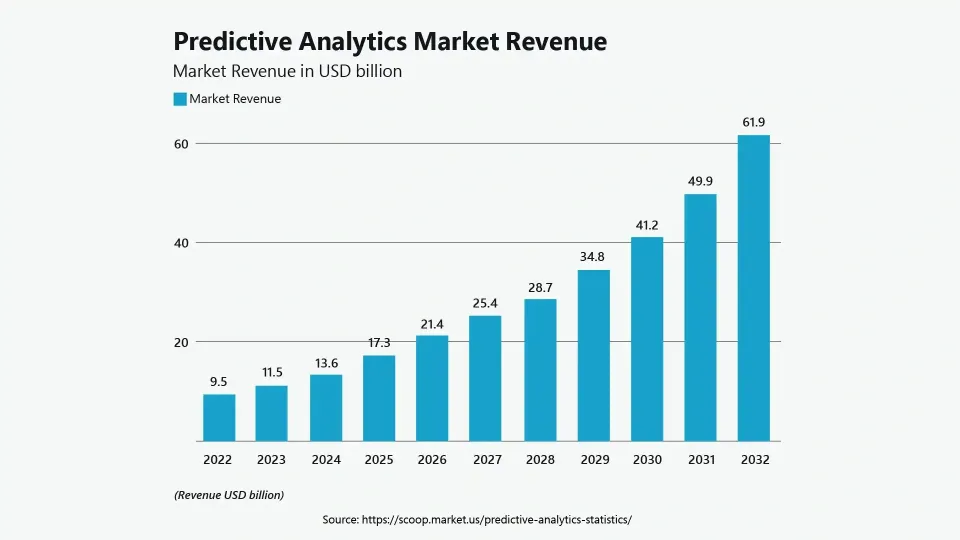
Predictive analytics is an important element in the data science industry, and it is growing at a CAGR of 21.2% to reach a market size of $41.2 billion by 2030, as per Market.US.
Though predicting the future often sounds compelling, a lot of predictive analytics projects fall short of expectations because of a variety of reasons, such as a lack of technical expertise, no clearly defined objectives, and other organizational challenges. Professionals looking to succeed in their data science jobs must understand these obstacles to address them efficiently.
In this article, let us discuss the core challenges that organizations across the data science industry must consider, along with their solutions to drive real business value.
Problem #1
Lack of Clear Business Objectives
The most common and one of the earliest predictive analytics challenges is starting with tools or models instead of business problems.
Data teams often rush into selecting the best platform or algorithm to ensure project success without even clearly defining the problem statement and question that they want to solve.
Without a clear objective, even the best models may not provide accurate insights. ultimately, measuring its success becomes difficult and fails to align stakeholders around a common goal.
Solution:
Data scientists must first define a clear and measurable question before they start exploring models or technologies. For example:
Setting such clear targets makes it easier to guide model deployment and set KPIs.
Problem #2
Data Quality, Accessibility, and Silos
We know models are as good as the data they are built on. Therefore, poor quality data is perhaps one of the biggest technical challenges in the data science industry.
This includes outdated, incomplete, inconsistent data across systems, or data stored in different silos that makes it difficult to consolidate and prepare for analysis.
Solution:
Organizations can significantly enhance their model’s accuracy and reliability by investing time in cleaning and organizing data upfront.
Problem #3
Technical and Model Challenges
Even if high-quality data is available, teams face the problem of selecting and maintaining the right model. Here are some common problems:
Some predictive models perform well on historical training data but struggle to generalize to new scenarios, aka overfitting
Models that are built on historical data also become stale over time and do not perform well when business conditions change
Most complex machine learning models are often difficult to interpret and are opaque that can erode public and stakeholder trust
Solutions:
Problem #4
Limited Technical Infrastructure for Deployment
Often in your data science career, you may find predictive models working well in test environments, but they do not perform as expected when deployed at scale.
Insufficient processing power, lack of real-time data pipelines, or isolated systems are some issues that become obstacles to automation and efficient integration.
Solution:
Investing in scalable infrastructure and modern data platforms can be a great step. It will support real-time data ingestion, version control, and automated model deployment. Data teams can also consider cloud services and MLOps pipelines that help deploy predictive models into a production environment.
Cloud-based deployment for predictive analytics solutions accounts for 36% of the market share, reflecting the growing popularity of cloud solutions. (Source: market.us)
Problem #5
Lack of Stakeholder Alignment and Communication
In your data science job, you will need to collaborate with data scientists, business leaders, operational teams, and others to make your predictive analytics model a success. But the problem lies here. These groups speak different languages. While data teams may focus on accuracy metrics, business users will talk about revenue or customer retention.
This difference leads to ineffective models that either don’t serve business needs or are not deemed effective in decision-making.
Solution:
Predictive Analytics Best Practices
Here are some predictive analytics best practices that can make your data science job easier:
Work on aligning your predictive model with measurable KPIs and real business value
Ensure you use high-quality, clean, and consistent data for your model to improve its reliability and accuracy.
First, launch a pilot project and measure its outcome. Refine the model as needed before scaling it across the organization
Thankfully, we now have AI-powered MLOps tools that can automate deployment, track performance, and retrain models regularly to prevent model drift
It is also recommended to involve business stakeholders early and use insights into workflows to get maximum output
Final thoughts!
Predictive analytics is transforming the data science industry; however, success is not guaranteed for all organizations implementing it. We saw the most common problems, including unclear objectives, lack of quality data, isolated systems, and siloed data, among others. We also discussed best practices and solutions for each problem.
By following these, data teams and organizations can ensure greater success for their predictive analytics models. Addressing these common predictive analytics challenges that limit proper outcomes, organizations can ensure long-term data-informed success.
Are you looking to succeed in your data science career and overcome these predictive analytics challenges? Data science certifications from USDSI® emphasize practical model development, data governance, ethical AI, and deployment best practices. It equips professionals with the latest industry-relevant data science skills to design, implement, and scale predictive analytics solutions effectively.
Frequently Asked Questions (FAQs)
They fail mostly because of poorly defined objectives, poor quality data, lack of communication, and integration into operational workflows.
Organizations can track KPIs like an increase in revenue, a reduction in customer churn rate, cost savings, process efficiency, etc., to measure the success of predictive analytics.
Models should be continuously monitored and updated periodically to address data drift or changing market conditions to ensure optimal performance.
This website uses cookies to enhance website functionalities and improve your online experience. By clicking Accept or continue browsing this website, you agree to our use of cookies as outlined in our privacy policy.