Enterprise engagement with quantum computing has become widespread, though production use remains rare. According to IQM's State of Quantum 2026 report, 89% of surveyed organizations report hands-on quantum computing activity, yet only 13% report any level of production deployment. This gap indicates that most organizations remain in an experimental phase, with very few having deployed quantum computing in a way that generates measurable operational value.
Becoming quantum-ready does not require deploying a quantum computer immediately. It requires restructuring how systems handle computation, data flow, and latency today, so that architecture does not become the constraint once hybrid quantum-classical infrastructure reaches broader viability. For most engineering teams, this groundwork begins with a limitation already present in their existing classical systems, also known as sequential computing.
Why Sequential Computing Struggles With Latency
Sequential computing processes instructions one after another, in a fixed order, with each step dependent on the completion of the one before it. This model has powered software architecture for decades and continues to perform reliably for many workloads.
The limitation becomes apparent under a specific condition. As data volume and computational complexity increase, sequential processing accumulates latency at every dependent step, and that latency compounds rather than stabilizes.
This is not solely a hardware constraint, rather it is architectural.
These three categories represent precisely the problem space quantum computing is being developed to address.
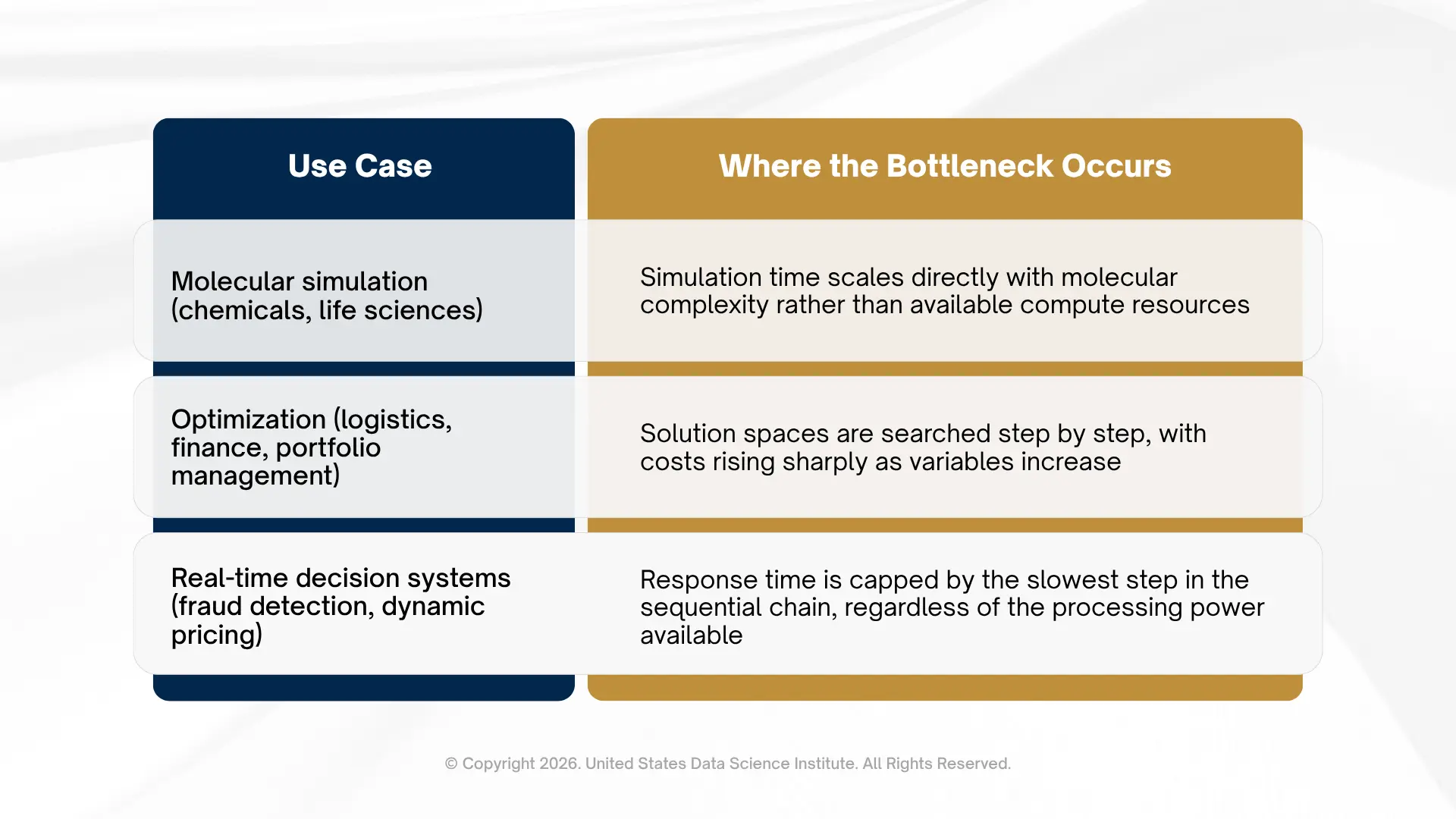
Sequential Bottlenecks in Practice
These limitations are not theoretical, as they appear consistently across several industry use cases. Listed below are the top use cases.
How Quantum and Parallel Architectures Address the Latency Gap
Quantum computing can process various possibilities at once, which is possible because of the principle of superposition and entanglement. Parallelism provides a structural benefit over sequential systems, which can be achieved only by adding hardware, for tasks such as simulation, optimization, and complex pattern recognition.
That does not imply that quantum computing will supersede classical infrastructure altogether. The majority of modern adoptions are hybrid in nature:
Becoming quantum-ready, in practice, means designing systems today that can identify which workloads are genuinely constrained by sequential dependency, structured so that a quantum or parallel processing layer can be introduced later without requiring a full architectural rebuild.
Steps to Build a Quantum-Ready Engineering Roadmap
STEP 1: Audit Existing Systems for Sequential Bottlenecks
Determine which workloads are genuinely constrained by step-by-step processing versus which simply require additional compute resources. Not every slow process reflects a latency problem worth addressing through quantum architecture.
STEP 2: Design Modular and Hybrid Capable Architectures
Design systems with a modular composition that allows for the implementation of a quantum parallel processing layer within certain components without affecting the system as a whole.
STEP 3: Prioritize the Right Problem Classes for Initial Pilots
Initially, begin with simulations, optimizations, and cryptography; these are the areas that have the most measurable impact when dealing with sequential latency. This can result in a subpar outcome if the pilot is too low on the workload and may present a less-than-impressive performance that will not gain traction in organizational support.
STEP 4: Treat Readiness as a Sustained Investment
Hiring, budgets, and pilot projects typically advance faster than the internal expertise and intellectual property required to scale them. Closing that gap requires ongoing commitment rather than a single initiative that is shelved after an initial proof of concept.
For a deeper look at how quantum computing is reshaping data infrastructure specifically, see USDSI®'s insights on quantum computing and open data systems, which examines how quantum-ready architectures intersect with modern knowledge systems.
Skills Engineers Need for a Quantum-Ready Future
Quantum-ready infrastructure depends heavily on how data is structured, moved, and processed at scale, making data fluency as important to this shift as quantum theory itself. Core skills worth developing include:
USDSI®'s data science certifications offer a structured path for data professionals building this foundation, covering advanced analytics, data architecture, and systems-level thinking required to work effectively across hybrid quantum-classical environments as they become more prevalent in production settings.
Final Thoughts
Sequential computing is not obsolete, but its latency ceiling is increasingly evident in the workloads that matter most, such as simulation, optimization, and real-time decision systems operating at growing scale. That ceiling will not resolve on its own, and additional compute alone does not fully address a limitation that is architectural at its core.
Organizations that begin restructuring their architecture now, well ahead of quantum infrastructure reaching full commercial maturity, will be positioned to adopt it without the delay of retrofitting systems built entirely around sequential assumptions. Quantum readiness, in this sense, is less about the technology itself and more about the discipline of building systems that do not assume latency is fixed.
FAQs
Is quantum computing ready to replace classical infrastructure entirely?
Not yet. Adoption today almost always follows a hybrid model, with quantum handling specific complex tasks while classical systems manage the rest.
Which industries are furthest along in quantum adoption?
Chemicals, life sciences, and financial services, largely because their work leans heavily on simulation and optimization.
What are the most in-demand quantum computing roles right now?
Quantum algorithm developers, hybrid systems engineers, and quantum error correction specialists are among the roles seeing the strongest hiring demand.
This website uses cookies to enhance website functionalities and improve your online experience. By clicking Accept or continue browsing this website, you agree to our use of cookies as outlined in our privacy policy.