Companies are rethinking what they expect from a data scientist. Employers still look for strong fundamentals, but they now want professionals who can work with AI tools, deploy models reliably, and explain results to business leaders.
Jonas Prising, Chair and CEO of ManpowerGroup, said of the company’s Q4 2026 Employment Outlook Survey across 42 countries, “This data demonstrates employers continue to place high value on human skills, even as the nature of work shifts with technological advancements.” Those expectations are already shaping hiring plans for 2027, and the eight skills below show where data scientists should focus their effort.
1. Python and SQL Programming
Python and SQL will continue to be the two main programming languages of data science in 2027, and the statistics tell us why. According to Stack Overflow’s Developer Survey of 2026, which had more than 30,000 participants, both languages scored 58% of responses, with only JavaScript ahead at 62%. As AI assistants generate more code, data science professionals will be expected to check it, validate its efficiency, and perform programming operations using SQL.
2. Statistics and Machine Learning Fundamentals
The development of tools will be continuous in 2027, yet good use of statistical reasoning will differentiate between valid studies and simply convincing explanations. Familiarity with regression, classification, clustering, time series, and experiment design, and effective use of software such as scikit-learn, statsmodels, and XGBoost, not to mention PyTorch, is what data scientists should acquire now.
In fact, as point-and-click technology takes over the process of modeling, it will be far more useful to have the skills to validate assumptions and comprehend uncertainty than just run the code.
3. Data Wrangling and Data Quality
Data preparation remains the aspect consuming the majority of project time. Companies will prefer specialists who are able to clean erroneous data, merge data sources, work with missing data, and set up checks that help to identify mistakes in early stages.
When reliable data work is in place, it secures every subsequent decision-making process. Moreover, it is usually the aspect distinguishing between something that serves solely as a proof of concept and some output that can be utilized by an organization.
4. Generative AI and AI-Assisted Workflows
Generative AI is set to become essential in coding, analysis, documentation, and reporting by 2027, and firms will demand data scientists who are able to work seamlessly with such tools and validate their outcomes. This trend is already underway. KPMG's third-quarter AI Pulse survey of 314 executives and leaders of organizations in the U.S. showed that 44% of firms adopted AI for their workforce, compared to 23% in the second quarter. One way to acquire this skill is through validation of output and documentation of the AI-enabled processes.
Read more: Explore how data professionals will direct and evaluate AI agents in Top 5 Agentic AI Trends for Data Science in 2027.
5. Feature Engineering and Data Modeling
In 2027, the model's quality will heavily rely on the inputs rather than the algorithm, and employers will seek data scientists with an ability to design powerful features and well-informed data models.
Feature engineering is the process of transforming, encoding, scaling, and selecting raw records into signals that a model can learn from. Data modeling is the organization of data in a way that maintains consistency, scalability, and facilitates easy access to data across cloud platforms. These skills work together to increase accuracy, minimize rework, and facilitate explanation of the results.
6. MLOps and Model Deployment
In 2027, data scientists will be expected to take models beyond the notebook and keep them reliable in production. That calls for working knowledge of MLOps, including versioning, testing, monitoring, retraining, and cloud deployment, so that results stay accurate after launch.
The gap is easy to see in the numbers. A BearingPoint survey of 1,050 senior leaders, fielded in August 2026, found that only 13% had scaled their AI initiatives fully in line with the original business case. As Frédéric Gigant of BearingPoint put it, “proving value and scaling value are two very different things.”
7. Data Governance and Responsible AI
Going into 2027, companies will require data scientists with knowledge of privacy, bias, documentation, and accountability, since models are playing an increasing role in making hiring, lending, medical, and customer decisions.
There are already signs of risk. According to BARC’s 2026 study, conducted among 234 data, AI, IT, and business leaders, as many as two-thirds of the companies surveyed have experienced an AI-related incident in the previous 12 months. Keeping track of data sources, making tests for unfair results, and clarifying how the model came to its decisions should become common practice, which builds trust with regulatory authorities, clients, and internal teams.
8. Business Acumen and Communication
Technical precision by itself will not guarantee data scientists’ success in 2027, as decision-makers require actionable insights. The professionals must be able to identify the business relevance of their problems and relate models to tangible achievements. The insight is coming from the top, as Gartner’s CEO Survey states that 44% of executives find it hard to show AI-generated profits to stakeholders. Data professionals who succeed in translating analysis into revenues will benefit from this situation.
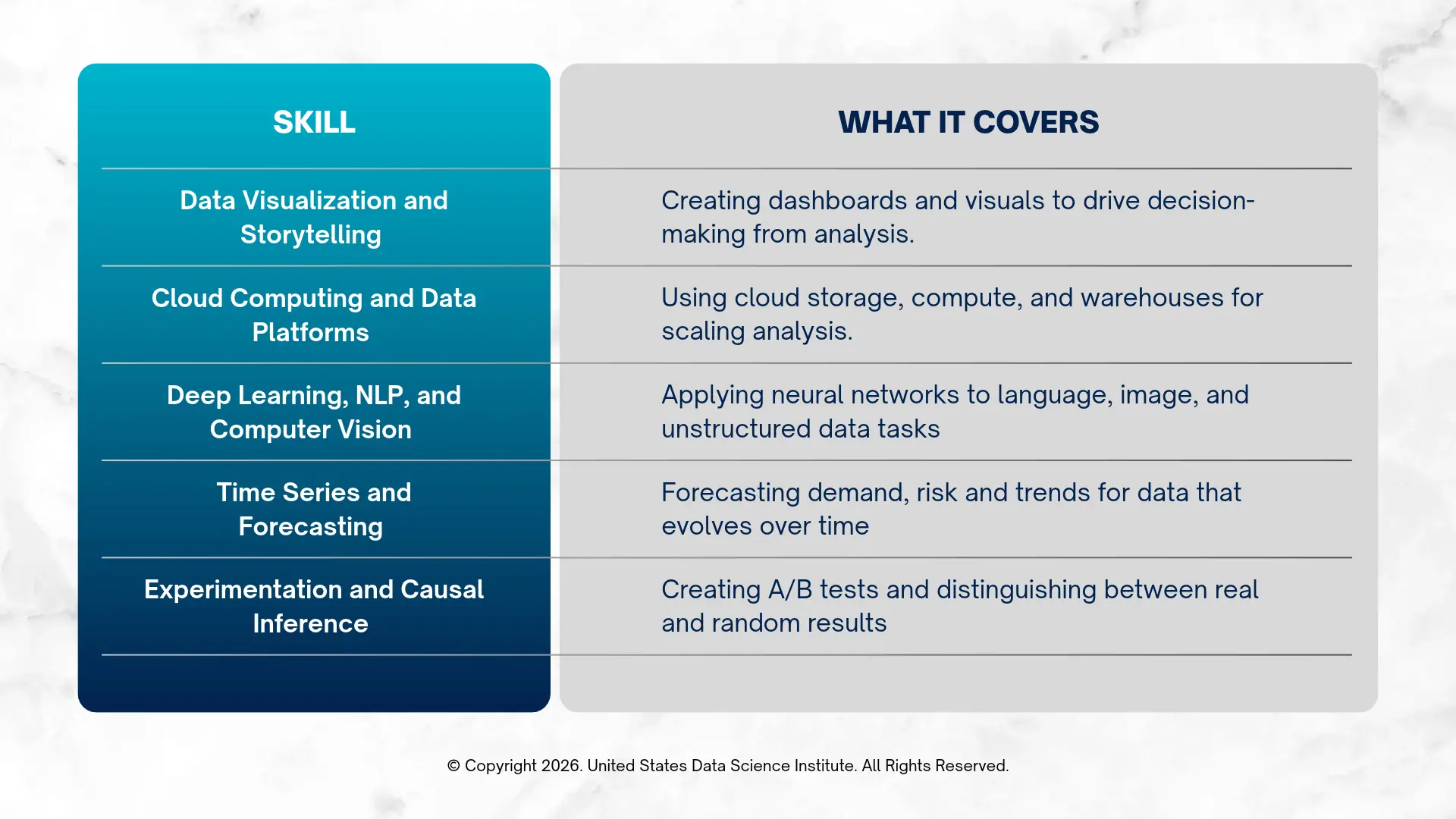
Data Science Skills Worth Watching
Beyond the core eight, these capabilities add depth and are worth developing as roles evolve toward 2027.
How to Build These Trending Data Science Skills
Upskilling works best when learning and practice move together. Start with the skill closest to your current role, then apply it in a project that runs from data preparation to deployment, with a short business summary. Structured learning gives that practice direction, and the USDSI® data science certifications offer three levels:
The Road Ahead
The data scientist’s expertise in 2027 is characterized by a mix of technical know-how and business sense. The professionals who know their foundations' business apply AI tools and the insights from their data processing will stand out here. It is recommended to start mastering the skills that relate to your working conditions first.
FAQs
Which industries are hiring the most data scientists?
Technology, finance, healthcare, retail, and manufacturing remain the largest employers, though demand is growing across most sectors.
Do data scientists need a master’s degree?
Not always, since many employers weigh portfolio projects, certifications, and practical experience alongside formal degrees.
Which data science job titles are growing in 2027?
Expect growth in roles such as AI engineer, AI agent developer, model evaluation specialist, and AI governance specialist, as data teams take on agent oversight and responsible AI.
This website uses cookies to enhance website functionalities and improve your online experience. By clicking Accept or continue browsing this website, you agree to our use of cookies as outlined in our privacy policy.