Machine learning models are only as dependable as the data and validation behind them. According to Further’s State of Enterprise AI Maturity report, only 5% of the 515 organizations surveyed believe their data is largely AI-ready. This highlights a critical challenge, even sophisticated models can produce misleading results when data preparation and validation are flawed.
Data leakage in machine learning is one such problem, and it is among the most common causes of an unreliable machine learning model evaluation. This blog explains the main types of leakage, the risks, and the practices that keep models reliable.
What is Data Leakage in Machine Learning?
Data leakage refers to the use of information during model training that is not accessible when making real predictions with that model. Such information might be obtained from the test set, or possibly from the future or from some variable that directly indicates an outcome.
For instance, in the case of a churn model developed using a variable that shows the date of cancellations, the model seems to have a high accuracy rate, while in reality such a variable does not exist for living customers. As no error arises on the training phase, the problem is usually noticed only once the model is deployed and brought into service.
How Data Leakage Distorts Model Performance and Accuracy
Evaluation is only used to find out how a model is going to behave when confronted with new data. That estimate becomes unreliable when data leaks corrupt it, and all decisions upon it become questionable. The major effects are listed below:
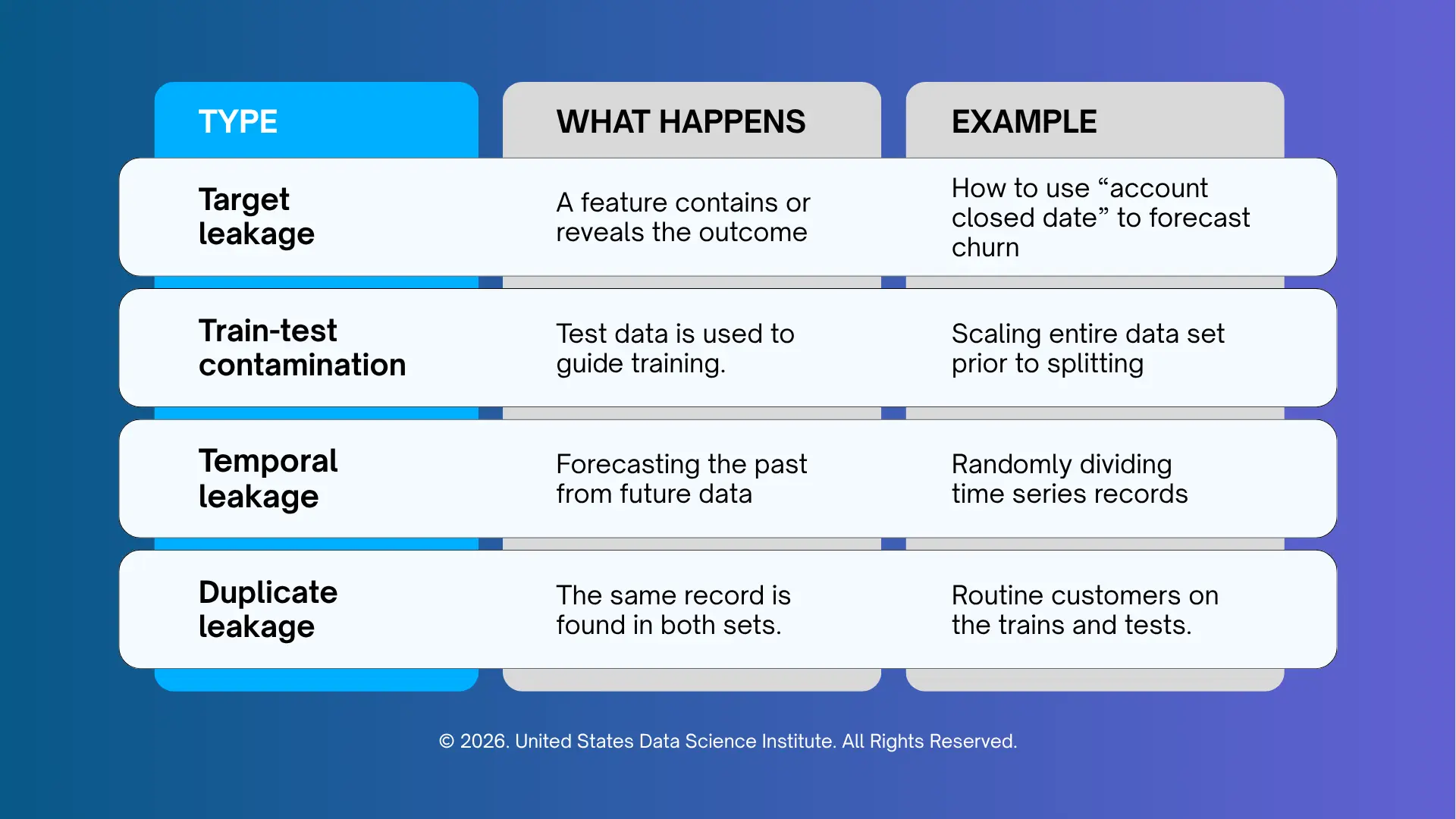
Key Types of Data Leakage in Machine Learning
There are several ways of data leakage occurring, which will allow the model to have access to information that it should not have had when making actual predictions. Understanding which type occurs will help teams understand where it comes from and the correct solution. There are four common types defined and explained below.
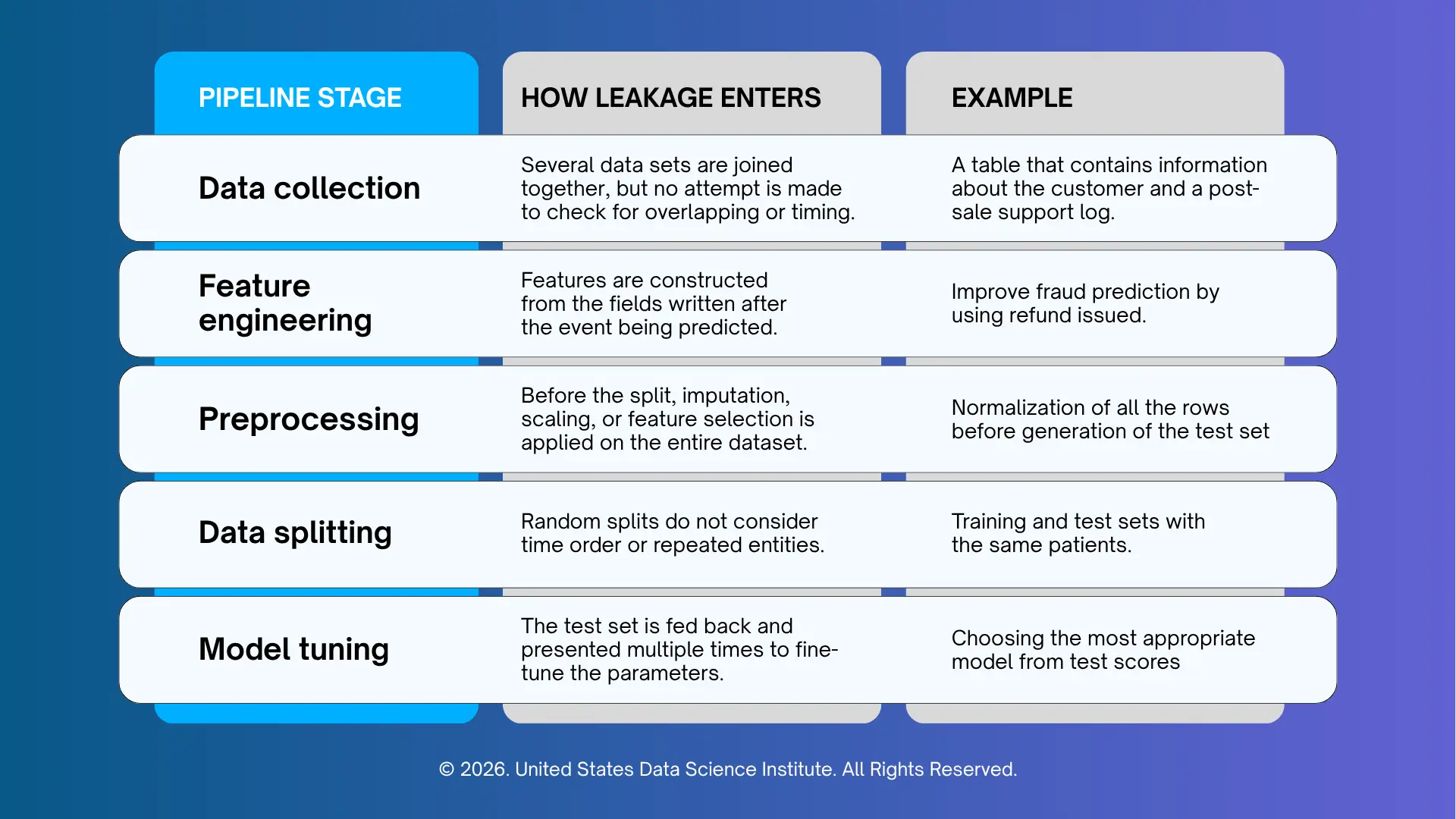
Where Data Leakage Enters the Machine Learning Pipeline
Leakage is caused solely by negligence. Instead, leakage is normally introduced during regular operations in a process. Leakage can occur at every stage from data collection to model tuning. The table below illustrates where leakage generally happens, where it is concerned.
Business Impact of Data Leakage in Predictive Models
The damage is not limited to analytics. A leaking fraud model may fail to identify real fraud. A leaking medical model may create an unwarranted confidence in the diagnosis. A leaking credit model may approve the wrong applicants.
Organizations face the risks of financial loss, compliance breach, and loss of trust from stakeholders. Fixing deployed machine learning models is much more expensive than preventing the problem before it occurs in the first place.
How to Identify and Diagnose Data Leakage
The ability to detect certain issues is reliant upon careful examination. Some indicators of a problem include:
It is important to analyze feature importance, connect every feature with its origin, and make sure that it will be present at the prediction moment. It is effective to prove the thesis on a completely new dataset.
Best Practices for Preventing Data Leakage in ML Workflows
Process discipline is a significant part of prevention. Listed below practices lower risk at each stage:
Building the Skills to Develop Reliable Leakage-Free Models
One of the skills that sets out a good data science professional is just running a model and the ability to identify a leakage. Employers want to see the professional has a thorough understanding of validation design, feature engineering, and pipeline testing. This applied knowledge can be validated by upskilling through structured learning done with USDSI® data science certification and combined with portfolio projects that illustrate how leakage was discovered and remediated.
Conclusion
Data leakage is a common occurrence that incurs a hefty cost. Recognizing the types of data leaks and being mindful of the causes and invisible threats can keep test results relevant. Organizations capable of treating validation and data governance with the same degree of seriousness as modeling are able to make systems that work correctly once implemented.
Frequently Asked Questions:
Is data leakage in machine learning the same as a data breach?
No, since a data breach exposes private information, while data leakage lets a model see information it should not have during training.
How is data leakage different from overfitting?
Overfitting means a model memorizes noise in its training data, whereas leakage gives it outside information that makes its test results look unrealistically good.
Can data leakage happen in large language models?
Yes, when test or benchmark content appears in the training data, scores become inflated and no longer reflect true ability.
This website uses cookies to enhance website functionalities and improve your online experience. By clicking Accept or continue browsing this website, you agree to our use of cookies as outlined in our privacy policy.