You must have heard quite often that data is the new oil. It is a raw resource that must be refined before it can be used for organizational benefits. But the real challenge is data explosions. Unlike oil, data is growing exponentially and becoming increasingly complex.
If enterprises do not manage this ‘wealth’ without a structured framework, data can become a huge liability.
Data governance is an excellent way of data management that includes the collection of processes, roles, policies, and standards that ensure organizations have high-quality and secure data as per their business requirements.
The global data governance market is projected to grow from $5.38 billion in 2025 to over $18 billion by 2032, exhibiting a huge 18.9% annual growth rate. (Source: Fortune Business Insights)
In this article, we will understand in detail what the key data governance principles are, why they are important, and best practices to implement data governance principles in the organization.
What is the need for Data Governance Principles?
Before we dive deeper, let us understand the importance of data governance and the benefits it provides to organizations in this highly data-driven business environment. It is the sheer scale and data risks associated with modern data environments that necessitate robust data governance principles. Gartner predicts that by 2027, 60% of data leaders will face critical failures in managing synthetic data, which will pose new risks to governance and compliance.
Most of the data security and industry standards, like GDPR, CCPA, HIPAA, etc., require organizations to handle data with extreme care.
This has led to a ‘garbage in, garbage out’ crisis, i.e., AI models are only as good as the quality of data they are trained on.
If there is no proper data governance, data teams can waste a lot of time reconciling conflicting reports.
Data governance principles provide structured guidance and ensure data is trustworthy, easily accessible, and secured.
What are Data Governance Principles?
Data governance principles in 2026 can be considered as a complete framework rather than a set of rules that ensures data is complete, ethical, accessible, and useful. Key data governance principles are explained below:
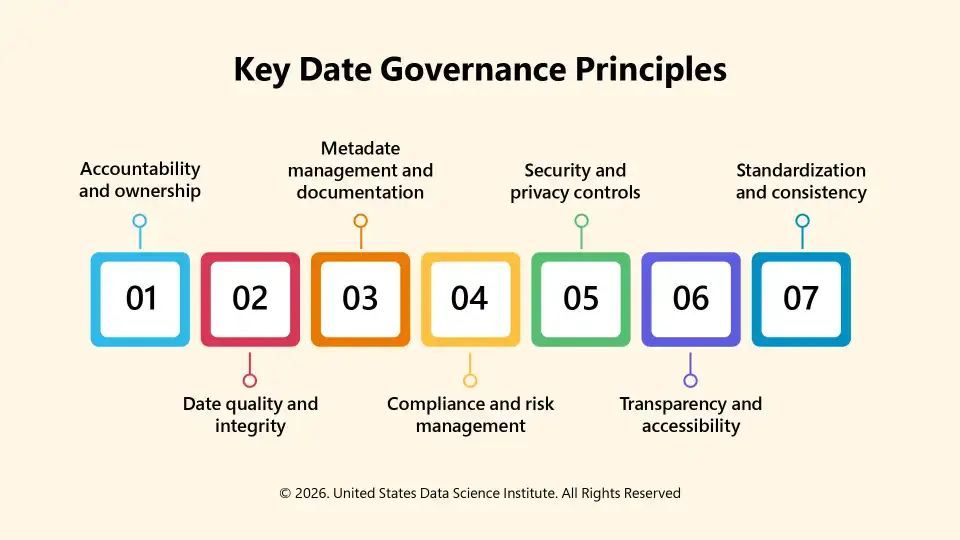
Every data should have a designated owner who will be responsible for its accuracy and security. Enterprises must establish a clear RACI (responsible, accountable, consulted, informed) matrix to avoid data degradation.
It is an essential element in the data governance principle that focuses on making data accurate, complete, consistent, timely, and valid.
This means users should be able to know and trace where data comes from. Managing data must include metadata management, consisting of a ‘data dictionary’, so that everyone agrees on the same definition.
Standardization refers to data being used consistently across all systems. It is essential to eliminate confusion and errors.
Compliance with industry standards and data regulations has become mandatory for all organizations to safeguard users' data privacy and ensure data security.
Data security is again a very important principle of data governance that helps protect users’ sensitive and confidential information from misuse and unauthorized access. According to Fortune Business Insights, approximately 88% of data leaders expect data security to be their highest priority throughout 2026, even ranking it above AI development.
This refers to the introduction of checks and balances between technical teams and businesses that use data in different forms.
Challenges of Data Governance
Though rewards are great, implementing a data governance strategy requires addressing some frequent challenges, such as:
Often, employees are hesitant about data governance as they think it will restrict them from efficiently using data
The biggest problem is departments using and guarding their own data in isolated systems. This prevents getting quality data from a ‘single source’.
Governance initiatives are also at risk because of a lack of support from leadership and a lack of dedicated funding.
If there is confusion over who owns specific data assets, for example, business teams or IT teams, then it can also lead to data responsibility and maintenance issues.
Sometimes it becomes difficult for organizations to keep up with rapidly evolving global privacy laws like GDPR or CCPA.
How to Implement Data Governance Hassle-Free?
It requires a consistent effort and a fast-scaling approach when it comes to implementing data governance principles in 2026 successfully. So, organizations must begin by identifying specific business problems and then applying a data governance strategy accordingly.
Here are the best practices that organizations can follow:
Every organization has different governance needs. Therefore, there is no common framework that applies to all. Start by identifying business priorities like compliance, data quality, security, or easy accessibility of data.
The next thing is appointing data owners and data stewards. There should be a governance council that will define responsibilities and approve policies.
Organizations also need to create clear policies for data quality, classification, data privacy, access control, data lifecycle management, and other data management activities to ensure consistent data is available across all departments.
Thankfully, there are several data governance tools for data catalogs, metadata management, data lineage, and access control tools. These tools can improve data visibility and traceability, and help enforce data governance policies effectively.
Finally, organizations should also track KPIs such as data quality scores and compliance metrics. Data professionals should also conduct regular audits. Training must be provided regularly to build a strong data governance culture in the organization.
Final thoughts
Implementing data governance principles has become a foundational requirement for all organizations in almost every industry. It is no longer an optional consideration for those who want to thrive and succeed in a data-driven business environment.
So, organizations should prioritize the above-mentioned key data governance principles, including accountability, security, transparency, data quality, standardization, etc., to reduce the risk of data mismanagement and utilize their data assets to their full potential. Of course, challenges exist, but by following the best data governance implementation practices, organizations can ensure their data is safe, ethical, and usable.
Professionals looking to learn and implement effective data governance principles and develop a data culture within their organization must consider the data science certification from USDSI® Certified Senior Data Scientist (CSDS™) that focuses on data science leadership traits.
Frequently Asked Questions (FAQs)
Data Management is the execution and technical implementation (the "doing"), while Data Governance is the strategic framework and policy-setting (the "planning" and "overseeing").
It is a shared responsibility between IT and Business. While IT provides the infrastructure, Business "Data Owners" are responsible for the definitions and accuracy of the data.
Study the core body of knowledge, pursue professional data science certification like CSDS™, or leverage online learning platforms to check relevant courses to learn data governance principles.
This website uses cookies to enhance website functionalities and improve your online experience. By clicking Accept or continue browsing this website, you agree to our use of cookies as outlined in our privacy policy.