A Data Ethics Toolkit for Data Scientists is defined as a set of governance principles, integrity controls, transparency practices, accountability mechanisms, and reciprocity frameworks employed in designing, deploying, and monitoring ethical data-driven systems. In modern Data Science and Technology, systems operate at scale, automate decisions, and influence real-world outcomes across various industries such as finance, healthcare, governance, and employment.
The global volume of data generated, consumed, and stored is expected to increase to 394 zettabytes by 2028, estimated by Statista. The growing volume of data also requires the right operations that turn raw, noisy data into useful insights, and responsible usage of the insight helps modern businesses in better data-driven decision-making.
Therefore, as today’s models gain autonomy and datasets get more complex, ethical risk is no longer an abstract theoretical concept but rather something we need to solve operationally.
What is Data Ethics?
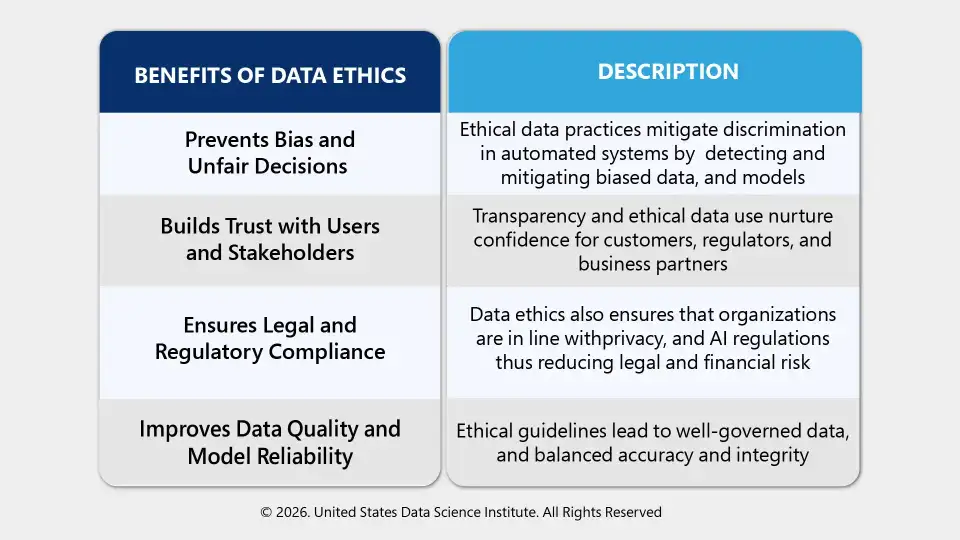
Data Ethics means using data in a responsible, fair, and transparent way, ensuring privacy, reducing bias, maintaining accountability, and protecting people from harm.
Top 5 Ethical Toolkits for Data Scientists in 2026
Today’s ethical failures are resulting in less outright unethical behavior, and more as a consequence of poor corporate governance, weak control over integrity mechanisms, and a lack of accountability. Let’s break down the Data Science ethical toolkit every data scientist must follow today.
1. Ethical Data Governance
According to Gartner's Data Governance Approach by 2027, almost 60% of organizations globally will fail to realize the anticipated value of their AI use cases, all due to incohesive data governance frameworks.
What is Ethical Data Governance in Data Science?
Ethical data governance determines who decides, what is permitted, and how data moves between collection, storage, sharing, and reuse. Even well-trained data scientists and engineers can accidentally cause harm without governance.
Responsible data governance ensures:
Tools for Ethical Data Governance:
For a data scientist, governance tools help them mitigate ethical risk before modeling begins.
2. Data Integrity: Ensuring Ethical Quality
Do you know how ethical data integrity enables better decision-making in today’s workplaces? Data Integrity involves maintaining the correctness of the data to determine whether the analytics are of the data that makes any analytics useful or misleading. Ethical data science decision-making also entails realizing that bias, conflicts of interest, and data misuse erode integrity even when models are effective.
Ethical data integrity focuses on:
Tools for Ethical Data Integrity:
Responsible data scientists think about integrity as something that’s a collective responsibility, not an afterthought.
3. Transparency
Fairness and transparency in data science and technology go beyond explainable AI. It keeps all stakeholders clear on intention, constraints, and trade-offs, not just outputs.
Ethical Transparency Supports:
Tools for Ethical Transparency:
The latest insight from Partisia stated that around 74% of consumers say they avoid companies that mishandle personal data in 2026. Ethical data science professionals don’t make transparency performative; they make it actionable.
4. Accountability: Assigning Responsibility in Automated Systems
Debunking your misconception: Automation does not reduce responsibility — it multiplies it. If you follow the right ethical practices, it adds accountability automatically.
Accountability ensures:
Tools for Ethical Accountability:
For data scientists and engineers, accountability mechanisms are a means to prevent the diffusion or denial of ethical responsibility.
5. Reciprocity: Preventing Extractive Data Practices
Now you might be thinking: What is Reciprocity in Data Science? Understand that vast majority of ethical failures occur where data flows in only one direction. The principle of reciprocity guarantees that contributors to data-driven systems derive value from the data they add.
Ethical reciprocity means:
Tools for Ethical Reciprocity:
A mature data science professional designs for mutual benefit—not silent exploitation. Note that there are concrete guideline frameworks developed by the global research community and data-ethics communities, which offer structured guidance for operationalizing such considerations in practice.
Upskill Your Knowledge on Ethical Toolkit
Understand that, as Data Science and Technology are evolving at a rapid speed, you need to develop Data Ethics to perform your tasks responsibly and prevent your workplace from ethical harm. You can guide a team on how to apply the ethical toolkit in today’s workforce.
For that, you can explore and gain understanding about it with a structured training, such as enrolling in the best Data Science certification in 2026, such as Certified Lead Data Scientist (CLDS™), and gain industry-relevant insights on ethical tools and techniques. Upskill to drive scalable data solutions guided by ethics!
Frequently Asked Questions
1. Can ethical tools be integrated into agile data science workflows?
Yes, the majority of governance and integrity tools function on an iterative basis.
2. Are ethical toolkits relevant for small data science teams?
Yes. Ethical risk is present regardless of team or dataset size.
3. Do ethical frameworks limit innovation?
No. They minimize failures downstream and promote long-term system sustainability.
4. How often should ethical audits be performed?
On regular intervals—whenever data is changed, or a model is redeployed.
This website uses cookies to enhance website functionalities and improve your online experience. By clicking Accept or continue browsing this website, you agree to our use of cookies as outlined in our privacy policy.