
Data volumes across industries are growing faster than most organizations can process them. The global big data analytics market stands at $108.79 billion in 2026, while the business intelligence market reached $41.16 billion in 2026, together representing the scale at which organizations are investing in data-driven decision-making, as per Mordar Intelligence.
Organizations that understand what big data analytics and business intelligence actually require, from storage design to analytical technique to governance, are the ones turning that investment into decisions that hold up under scrutiny. Let us explore what that actually looks like in practice.
What Big Data Analytics Actually Involves
Big data analytics is the process of examining large, complex data sets to uncover patterns, correlations, and trends that support decision-making. The data involved carries three defining characteristics:
Modern analytics systems ingest data from multiple sources, run it through processing pipelines, and make it available for analysis, the objective being to extract value within a time frame that permits action.
Where Business Intelligence Fits In
Business intelligence refers to the technologies, processes, and practices used to collect, integrate, and present business data in a way that supports reporting and operational decisions.
The components of BI include data integration, data warehousing, query and reporting tools, dashboards, and performance management systems, each serving a distinct function in the chain between raw data and the insight an executive eventually reads.
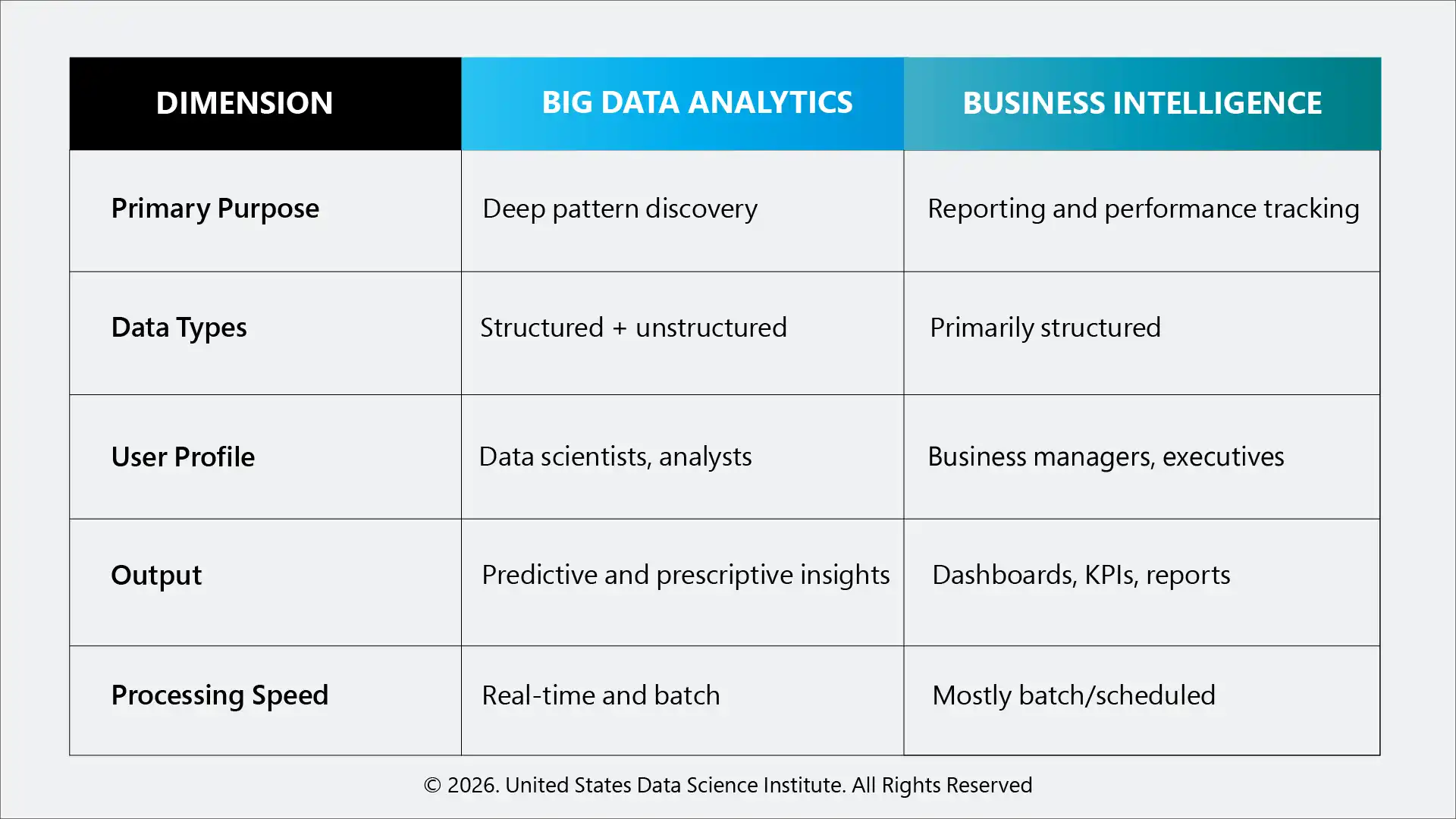
Where analytics focuses on depth and discovery, BI focuses on accessibility and operationalization. The table below breaks down how the two differ across key operational dimensions.
How Do Both Work Together
The relationship between analytics and BI is sequential. Raw data enters the system, is processed and cleaned through analytics pipelines, and then surfaces in BI tools as actionable metrics.
Without the analytics layer, BI tools have nothing reliable to display. Without the BI layer, analytical outputs remain inaccessible to the business functions that need to act on them.
Role of Data Architecture in Pipeline
The quality of any analytics and BI output is directly tied to how data is stored, governed, and moved across the organization. Poorly structured pipelines create bottlenecks, inconsistencies, and cost overruns that erode the value of even sophisticated analysis.
As explored in Why Data Architecture Is Critical for Building Scalable AI Systems, the underlying infrastructure, how data is organized from warehouses through to consumption layers, determines whether analytics outputs are trustworthy or flawed. The same principle applies to every BI deployment; a weak data architecture produces unreliable dashboards regardless of how capable the tool is.
Core Analytical Techniques Used in Big Data Environments
Organizations apply different analytical techniques depending on the questions they are trying to answer. The 4 common techniques include:
At both the predictive and prescriptive ends of this spectrum, machine learning is at the centre. Machine learning algorithms learn from large amounts of data and are able to adapt their decisions over time as new information becomes available, which makes them ideal for demand forecasting, fraud detection, and the modelling of customer behavior.
What Business Intelligence Delivers Across Functions
BI is not a technology investment in isolation; it is an operational one. When implemented against clean, well-governed data, it changes how decisions are made across the entire organization.
Common Challenges Organizations Face
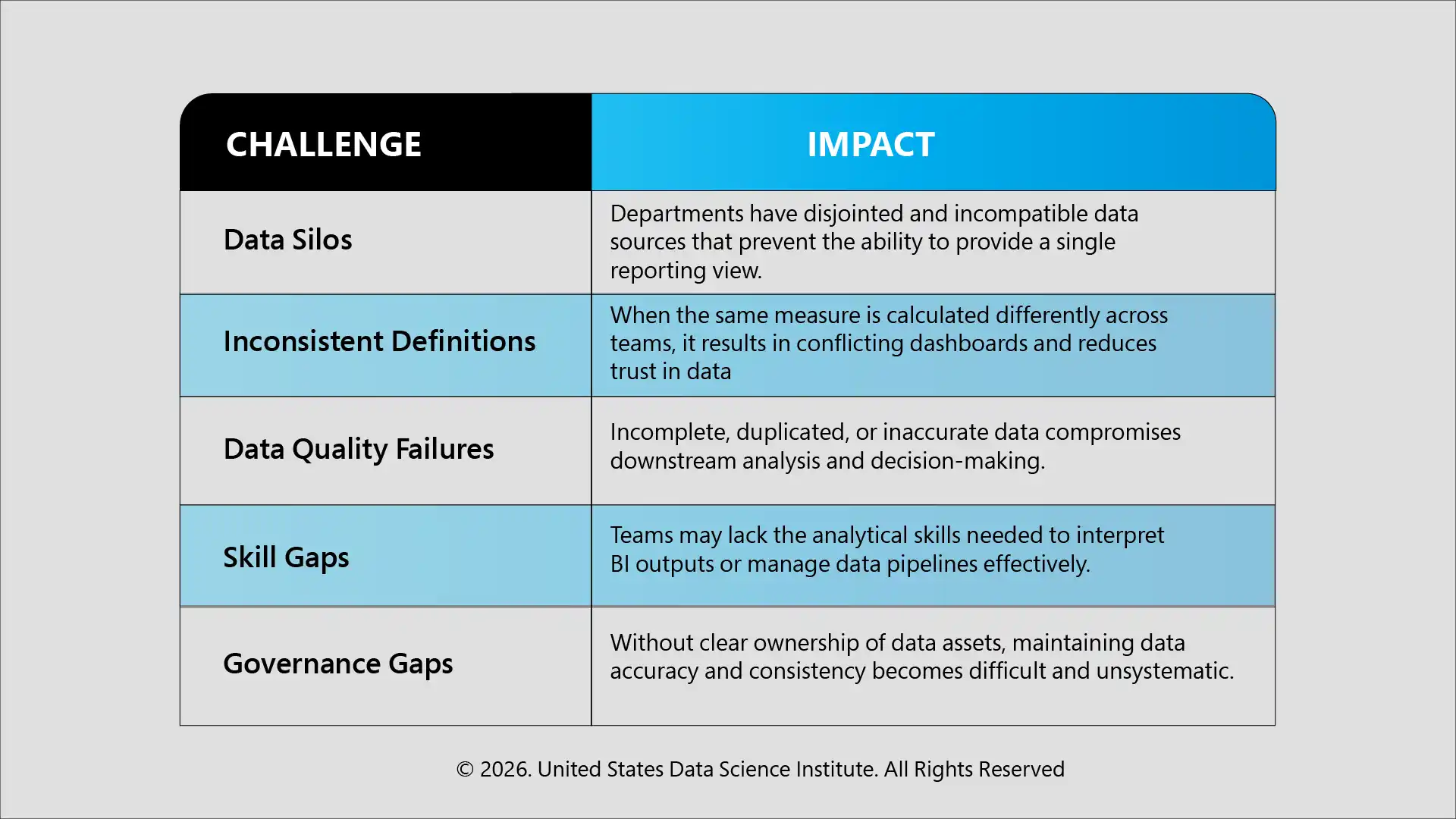
Despite widespread investment in big data analytics and business intelligence, many organizations fail to extract consistent value. The reasons are well documented and largely preventable.
Resolving these challenges is not a matter of buying a better tool. It requires process design, governance discipline, and a workforce with the right technical foundation.
Upskilling for Future-Forward Analytics and BI Roles
As analytics and BI functions become central to organizational strategy, the demand for certified professionals will rise. For those looking to build structured expertise in data science, statistics, and analytics systems, USDSI® data science certifications offer a recognized path to demonstrate and validate those competencies across 160+ countries.
Big data analytics and business intelligence are only as strong as the foundation beneath them. Organizations that get the architecture, governance, and talent right do not just produce better reports; they make faster, more confident decisions at every level.
The demand for professionals who understand this full pipeline is growing. The organizations investing in that capability now are the ones that will outpace those still treating BI as a reporting tool.
FAQs
What skills are most in demand for professionals working in big data analytics and business intelligence?
SQL, Python, data visualization, statistical modeling, and familiarity with BI tools such as Tableau or Power BI are the most consistently sought-after skills across analytics roles.
What job roles typically work at the intersection of big data analytics and business intelligence?
Data analysts, BI developers, data engineers, analytics managers, and data scientists are the primary roles that operate across the analytics and BI pipeline.
Do BI and big data analytics roles require a background in computer science?
Not exclusively; professionals from statistics, mathematics, business, and engineering backgrounds regularly transition into analytics and BI roles with the right technical upskilling.
This website uses cookies to enhance website functionalities and improve your online experience. By clicking Accept or continue browsing this website, you agree to our use of cookies as outlined in our privacy policy.