
The rise of agentic AI is reshaping what organizations think about artificial intelligence. Unlike traditional AI systems that just respond with answers or predictions, agentic AI systems can reason, plan, act, and even correct themselves more efficiently and without human supervision. According to a 2025 survey by Cloudera, 96% of enterprise IT leaders reported plans to expand their use of AI agents within the next 12 months
Preparing high-quality data for such systems ensures a strong foundation and a high-quality AI model. Without well-prepared data, AI agents will not be able to deliver reliable and actionable results.
In this article, we will explore how to prepare data properly for agentic AI, from defining data requirements to governance and readiness for autonomous workflows.
1. Understanding Data Requirements for Agentic AI
Agentic AI systems are quite different from traditional AI or BI tools. In a recent article titled “AI Agents in Data Analytics: A Shift Powered by Agentic AI”, we discussed that agentic AI adds a new degree of intelligence than just simply following command and responding. This helps systems to reason through ambiguous problems, understand business context, and break down large tasks into smaller tasks that can be attended autonomously.
Because of that, the data used to train such systems must be more comprehensive than normal datasets. Agentic AI requires the following types of data:
A holistic view of data is needed to prepare agentic AI workflows, not just as static records but as important assets that also support reasoning, memory, and action.
2. Defining Clear Objectives for Your Agentic System
Before you start collecting data, it is important to define what you want your AI agent to achieve. You will need to create different data strategies for different use cases.
For example:
Mapping an agent’s task to data requires clearly defining what data to collect and how to structure, label, or store it.
3. Data Collection: Best Practices
The following principles must be considered while gathering data to feed AI systems:
4. Data Quality Foundations
Agentic systems don’t just analyze but act. This makes data quality a very important part of agentic AI systems. Because not doing so can lead to incorrect and harmful decisions. A high-quality data preparation requires:
Without proper data cleaning, there are chances that agentic AI may misinterpret and act differently, which could damage trust and exacerbate errors.
5. Structuring Data for Agentic Workflows
Structuring data to support multi-step reasoning, retrieval, and action ensures leveraging the full potential of Agentic AI systems. Therefore, the following points must be considered:
The blog article “AI Agents in Data Analytics: A Shift Powered by Agentic AI” outlines how agentic AI is revolutionizing data analytics by enabling autonomous multi-step workflows, from data cleaning and blending to complex queries, forecasting, anomaly detection, and automated reporting.
This is essential so that agents can interpret data correctly and perform their assigned duties without any mistakes.
6. Preparing Behavioral and Interaction Data
A lot of agentic applications where user interactions, personalization, and adaptive decision-making are required; behavioral and interaction data for agentic AI play a very important role. This involves:
Such data helps agents easily adapt and learn from past decisions and improve future recommendations.
7. Data Governance and Compliance
Agentic AI systems can perform a lot of tasks, like trigger workflows, send alerts, update systems, and there are even AI agents for data analytics. Therefore, strong data governance is required to maintain security and privacy. Data science professionals must therefore prepare for:
By adhering to compliance, organizations can ensure their agentic systems can be used confidently with minimal risk.
8. Validating Data for Agentic AI Use
Finally, it is important to validate data for agentic AI before deploying the models. This includes:
Data validation ensures agents behave safely as predicted before they can be deployed for real-world decision-making and automation processes.
Primary use cases for AI agents emerging in enterprises: performance-optimization bots (66%), security-monitoring agents (63%), and development assistants (62%). However, and critically for data preparation, only ~12% of organizations report that their data is of “sufficient quality” to support effective AI (or agentic AI) systems, according to a recent industry article.
Common Challenges and How to Overcome Them
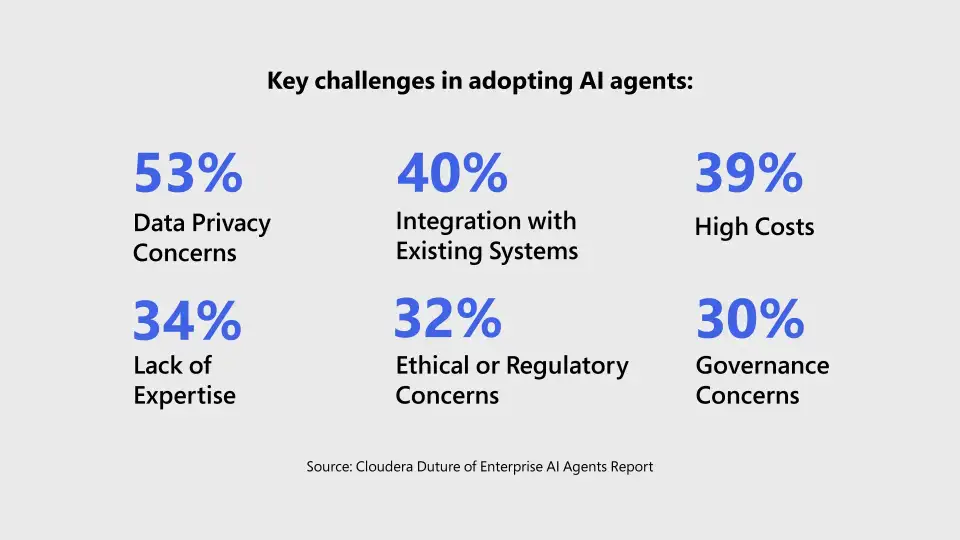
Now, let us understand some common challenges that often come across data teams in preparing data for agentic AI.
These data are hard to annotate or label.
Solution – Enforce metadata standards and context capture from the outset
This happens when data comes from limited sources.
Solution – Ensure data is collected from diverse sources. Also, simulate edge cases and perform stress tests with varying scenarios
This requires combining structured tables, logs, text, and behavioral data.
Solution – Use flexible data stores like graphs and vector DBs and modular pipelines.
Conclusion
Agentic AI is a big leap in the world of AI and transforming reactive analytics to proactive and offering autonomous decision-support and action. But the success of such systems depends directly on the quality and structure of the data that powers them.
By defining clear objectives, collecting data from diverse sources that are also rich in context, and enforcing data quality and governance, organizations can maximize the potential of agentic AI by simultaneously reducing risks.
Data science certifications from USDSI® train professionals on how to effectively build and maintain quality data for agentic AI systems and other data science projects, ensuring long-term success. In the era of agentic AI, data is the most important thing that powers reasoning, planning, and action. So, investing in proper data preparation means investing in reliable, scalable, and intelligent agentic systems for the future.
This website uses cookies to enhance website functionalities and improve your online experience. By clicking Accept or continue browsing this website, you agree to our use of cookies as outlined in our privacy policy.