The Python DataFrame ecosystem entered a genuinely new phase in 2026, and the timing wasn't coincidental. Pandas released version 3.0, bringing dedicated string data types, default Copy-on-Write behavior, and real performance improvements to a library that had gone years without a major overhaul. Polars, meanwhile, kept building on the momentum it had already established, continuing to draw attention for its focus on parallel processing and modern, large-scale data workloads.
Anaconda's 2026 own research found that data-quality issues derail 45% of organizations' AI scaling efforts, a finding that puts renewed weight on the tools developers actually use to clean, transform, and analyze data in the first place. With both libraries evolving at once, the comparison between Pandas and Polars has become more than a matter of preference. Let's discuss the key differences between the two and what they actually mean for how each one gets used.
Polars vs Pandas: Key Differences at a Glance
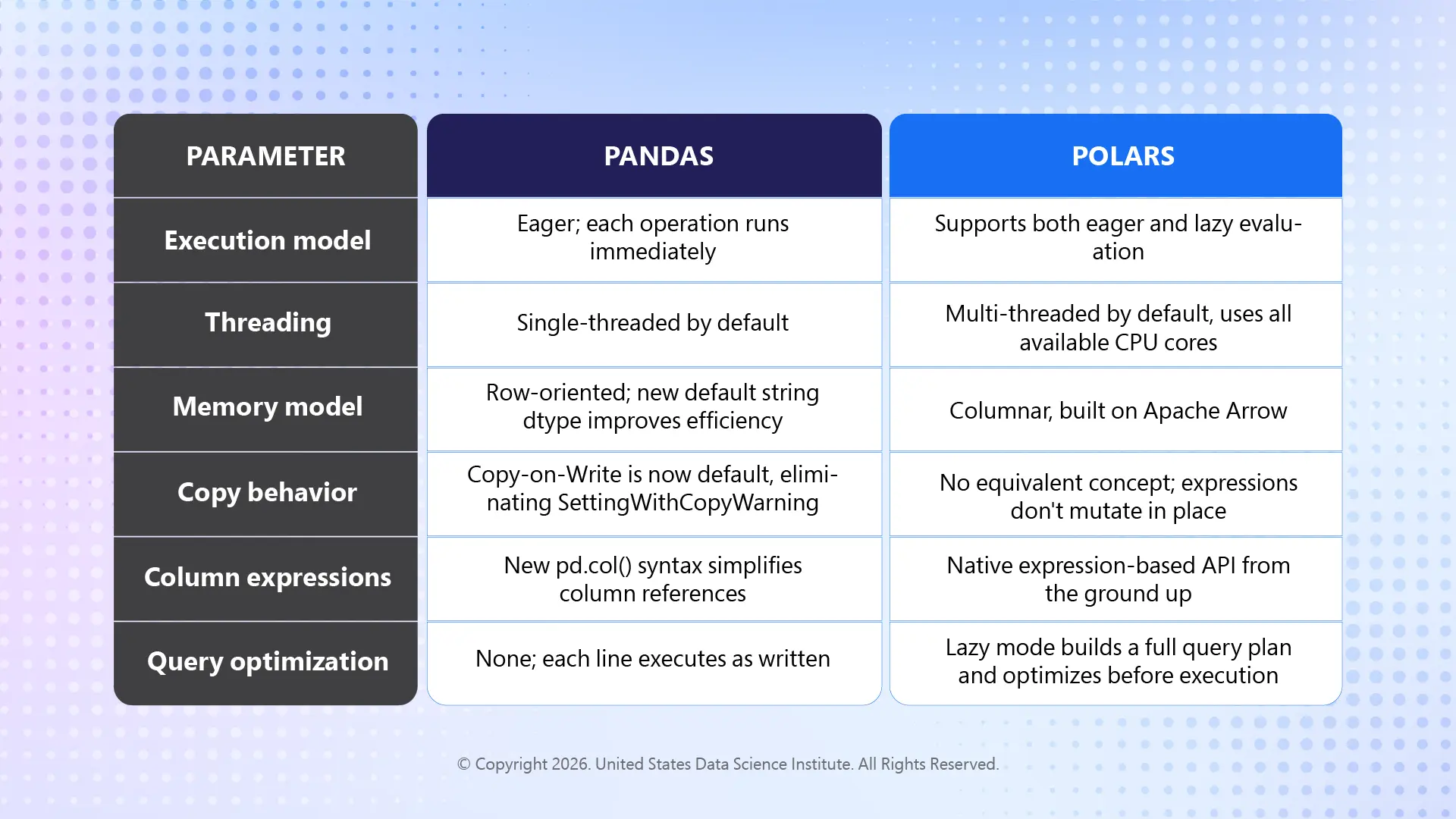
The two libraries diverge at the architectural level, not just in syntax. The table below breaks down the core distinctions before the deeper sections that follow explain why each one matters.
Performance and Memory Efficiency
Three architectural choices give Polars its performance edge over pandas on larger workloads as listed below.
Polars runs multi-threaded by default, using every available CPU core without manual configuration. Pandas remains single-threaded for standard DataFrame operations, even after the 3.0 update.
Polars' columnar Apache Arrow format avoids the repeated intermediate object creation that pandas' row-oriented, eager model produces. Pandas 3.0 narrows this gap somewhat, its new string dtype delivers up to 4.5–6.6x faster string operations, but the underlying execution model remains eager and single-threaded.
Lazy evaluation lets Polars optimize an entire operation sequence, including filtering, grouping, and joins, before execution, rather than processing each step in isolation.
Syntax, Ecosystem, and Scalability
Pandas' syntax remains deeply familiar, largely because it's usually the first library most Python data professionals learn, and its ecosystem advantage runs deep alongside that familiarity. Listed below are the key strengths of each.
Pandas:
Polars:
Polars vs Pandas: Which One Should You Choose?
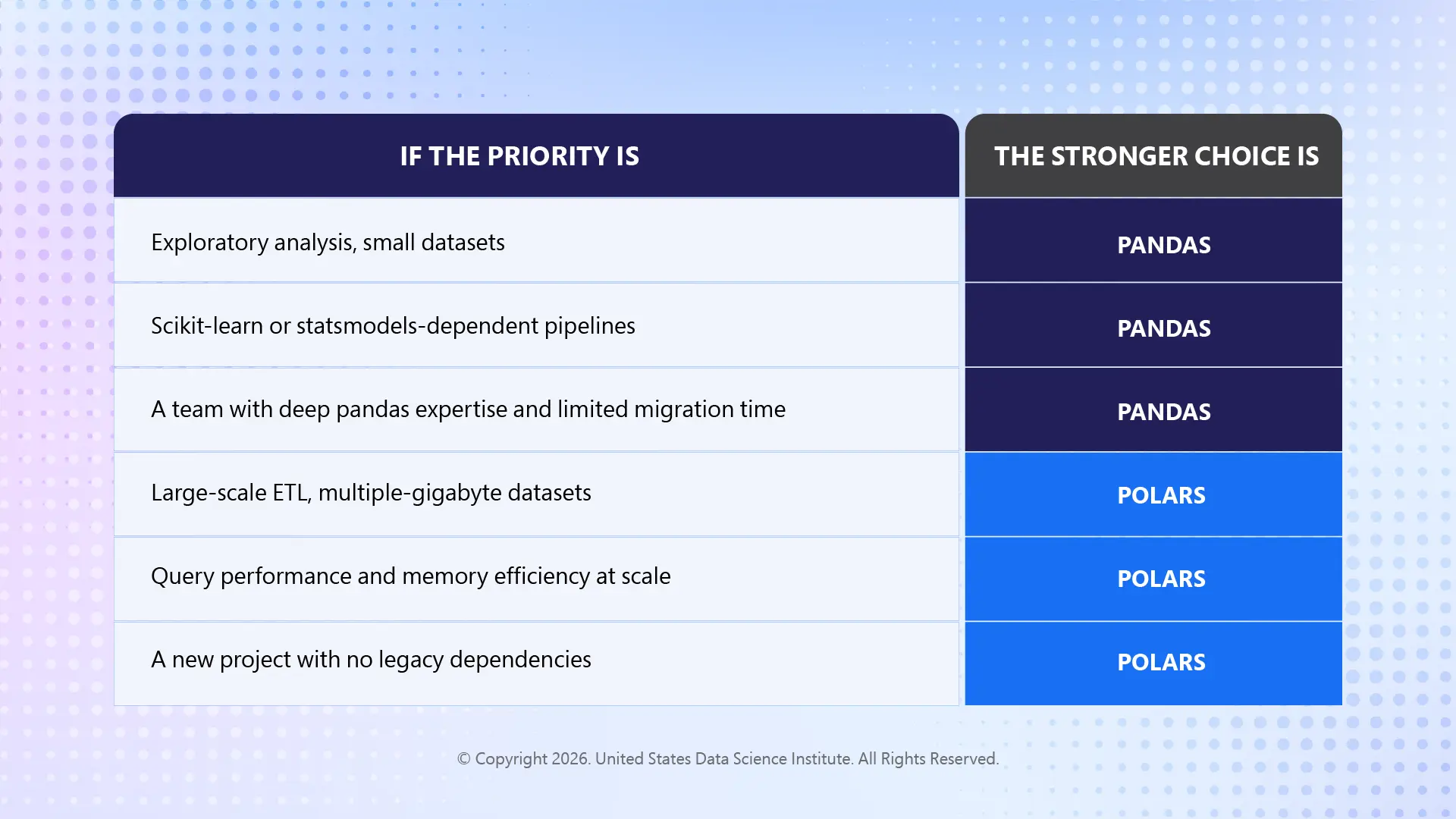
Choosing based on project requirements rather than habit is the more useful frame than picking one library permanently. In practice, most teams don't fully replace pandas; Polars handles heavy preparation and transformation, and the result is converted into a pandas DataFrame at the point it needs to interface with existing tooling.
Curious how AI is already changing what you can do inside pandas itself? USDSI®'s guide, on PandasAI Explained, breaks down how natural language querying, automated visualization, and dataset cleansing now sit directly on top of the Pandas ecosystem.
The Future of Python DataFrames
Both libraries are positioned to keep advancing in parallel. Pandas will continue modernizing incrementally, building on the performance and safety improvements 3.0 already introduced, while Polars will continue extending further into production-scale workloads as its ecosystem matures. The direction for the Python data landscape is clear that both tools are becoming standard, each selected deliberately based on the workload at hand.
What remains essential as the tools themselves evolve is the judgment required to choose between them, evaluating architecture, weighing tradeoffs, and matching the right technology to the actual problem. USDSI® Data Science certifications develops this capability directly through structured learning in data architecture, processing frameworks, and technology evaluation, offering professionals a formal pathway to build analytical judgment.
Conclusion
What matters going forward is not which tool ultimately wins but whether a professional has the judgment to choose deliberately between them, evaluating dataset size, execution requirements, and ecosystem dependencies, based on the actual demands of each workload, rather than defaulting to whichever tool happens to be most familiar. That capability, more than familiarity with any single library, is what will distinguish effective data professionals as the tools themselves continue to evolve.
FAQs
Is learning Polars becoming a distinct job requirement, separate from general Pandas skills?
Increasingly, yes, particularly for data engineering and large-scale ETL roles, though pandas remains the broader baseline expectation.
Does switching to Polars require rewriting an entire existing pandas codebase?
Not necessarily. Many teams adopt Polars incrementally for new, performance-sensitive workloads while leaving stable, working Pandas pipelines untouched.
Is Polars only useful for very large datasets, or does it help with smaller ones too?
Its advantage is clearest on larger datasets; for data under roughly a gigabyte, pandas, especially with 3.0's improvements, typically performs comparably, making the switch less critical at that scale.
This website uses cookies to enhance website functionalities and improve your online experience. By clicking Accept or continue browsing this website, you agree to our use of cookies as outlined in our privacy policy.