
A model that performs well on its training data can still fail once it encounters real, unseen data, and that gap is precisely what cross validation exists to catch. Cross validation is a model evaluation technique that splits a dataset into multiple subsets, trains on some portions and tests on the remainder, and repeats across several combinations to produce a more reliable estimate of how well a model will actually generalize.
A 2026 review published in Frontiers in Artificial Intelligence synthesized nearly a century of research on overfitting, finding that evaluation protocol design remains a core factor distinguishing models that generalize well from those that quietly fail in production. Cross validation sits at the center of that protocol, which is why understanding it properly matters beyond surface-level familiarity with the term.
Why Cross Validation Matters in Model Evaluation
A single split of the training set can give an overly positive or negative estimate of performance, depending on which data points were selected for the test set. Cross validation takes this head-on by assessing a model on several different partitions of the same data and computing the average performance score, which is a true measure of the model's performance and is not dependent on one good or one bad split of the data.
Key Cross-Validation Techniques For ML Practitioners
Not every dataset calls for the same evaluation approach, and choosing the wrong one can quietly undermine otherwise solid results. The five techniques below cover the situations a practitioner is most likely to encounter.
K-Fold Cross Validation
The K equal-sized folds make up the dataset. The model trains on K-1 folds and tests on the remaining fold. This process is repeated K times until each fold serves as a test set once. In practice, five- and ten-fold are the most commonly used options.
Stratified K-Fold Cross Validation
An imbalanced-class version of standard K-Fold. This means that the proportion of each class in each fold is identical to the proportion of each class in the whole data set, so that one fold does not have to be a minority.
Leave-One-Out Cross Validation (LOOCV)
An extreme form of K-Fold where K is the total number of data points. In each trial, the data set is split into the training set and the testing set, with one data point being held out. The training set is used for training, while the testing set is used for testing. It's very thorough but time-consuming, so it's only practical for smaller sets.
Repeated K-Fold Cross Validation
The result of the standard K-Fold may change when the data are split differently in a different execution of the algorithm. A repeated K-Fold does this by repeating the whole process of K-Fold “K times” with different splits and taking an average of the results to get a more robust estimation.
Time Series Cross Validation
Unlike other data types, time series data is not necessarily independent of one another because the information available to predict the past is different from the information available to predict the future, which is referred to as data leakage. Time series cross validation does not, however, follow the time series order; it sequentially trains on data that has been collected earlier and tests on data that has been collected later.
A Worked Example: K-Fold Cross Validation in Python
K-Fold using a real-life dataset provides a good understanding of the concept. KFold and cross_val_score from the scikit-learn library are used in the implementation process with the Iris dataset being applied. The Iris dataset is a small dataset with details for 150 flowers from three different species.
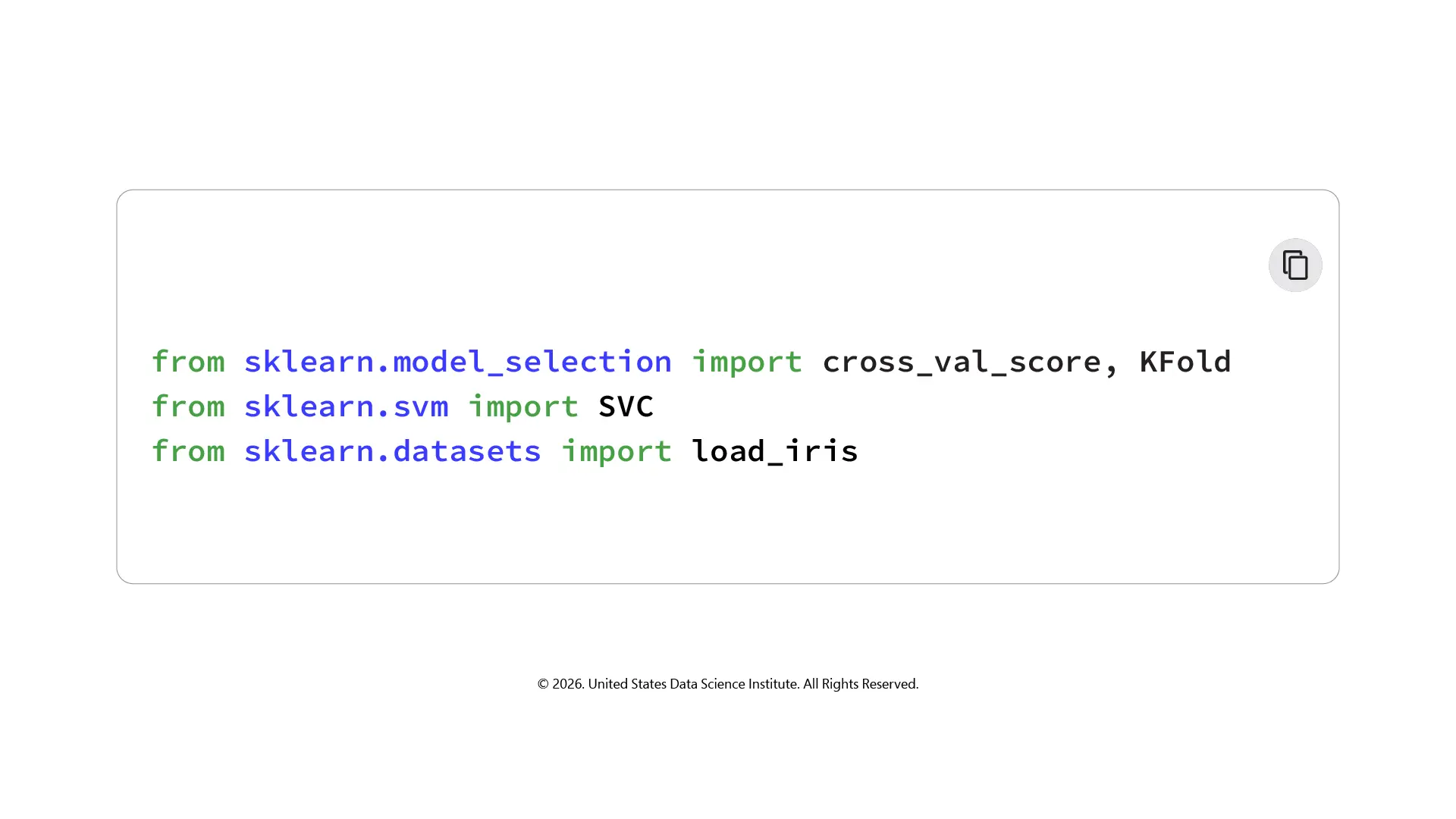
Step 1: Import the required libraries
Three parts provide the core work here: KFold tells how the data is split, cross_val_score does the training and evaluation loop for you, and SVC is the classifier that we're testing.
Step 2: Load the dataset
The Iris dataset is directly imported from the built-in datasets of scikit-learn, and the features and labels are split into two variables.

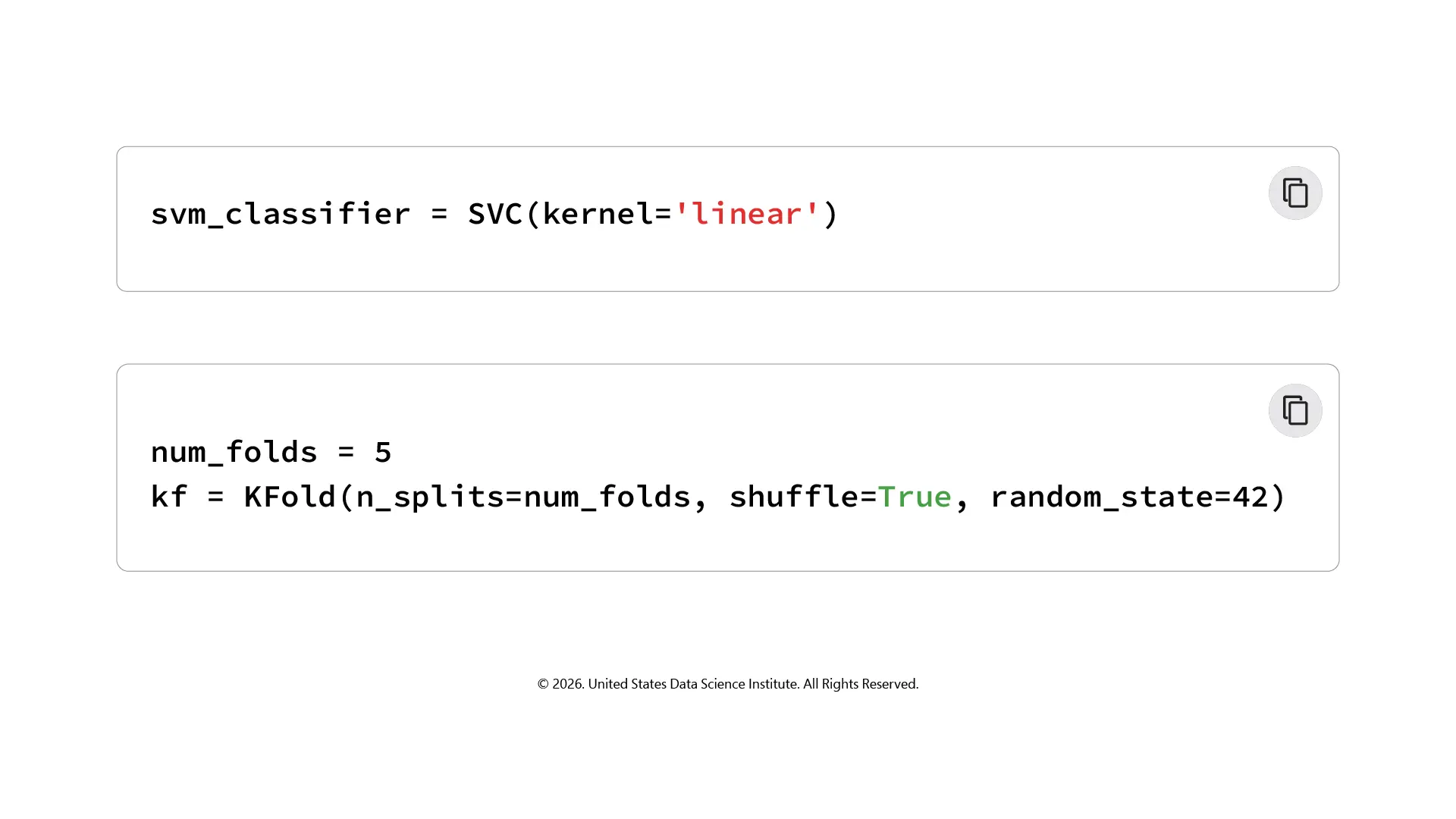
Step 3: Define the Model and Configure the Folds
The model evaluated here is a support vector classifier with a linear kernel. The fold count is set to five, which means the data set is split into five parts. The data is shuffled before the split, and a fixed random seed ensures the fold assignments are randomized but reproducible across runs.
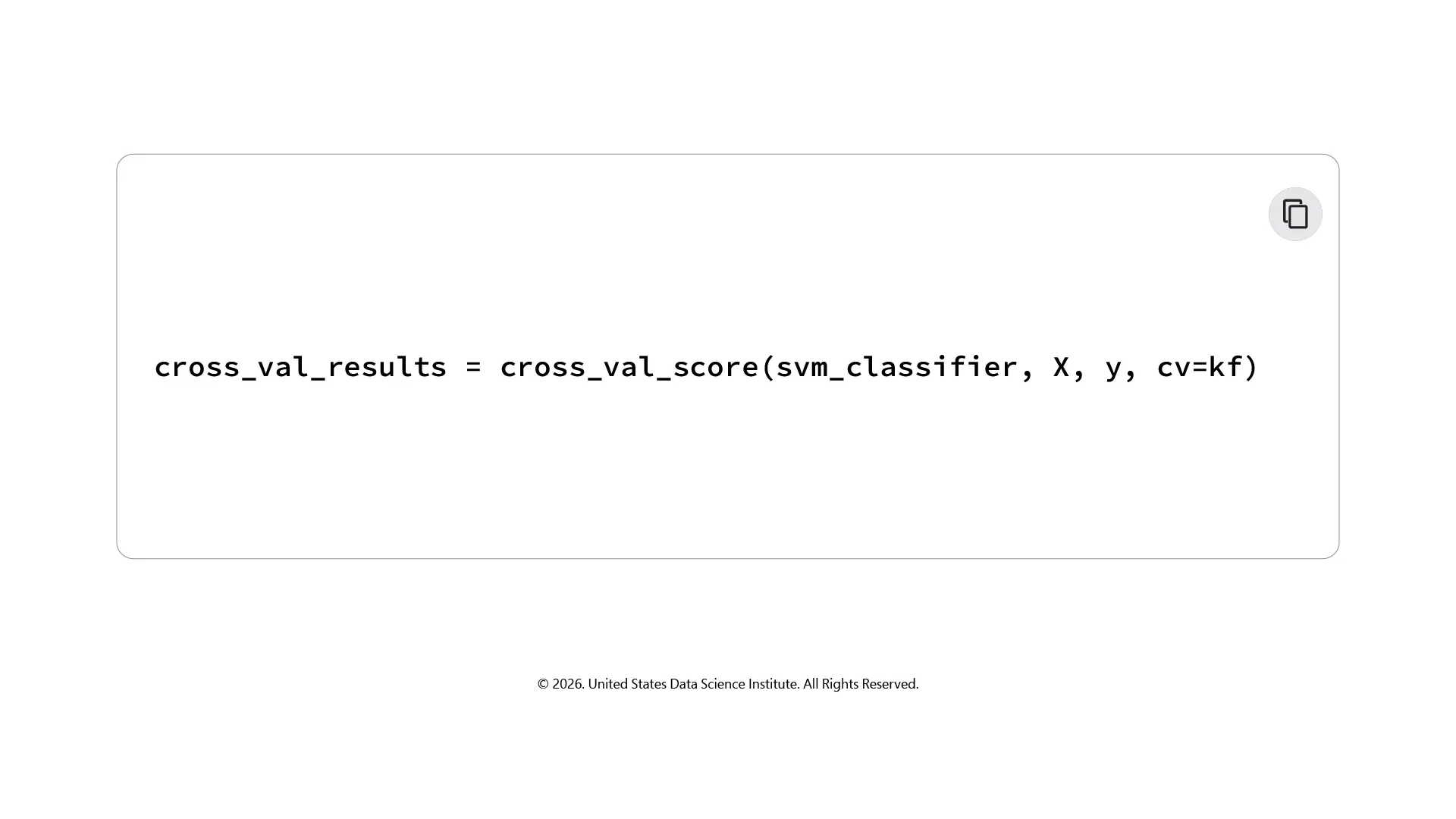
Step 4: Run the cross-validation
The scoring function takes care of the whole loop automatically. The function will train on 4 folds and test on 1 fold, do this 5 times separately, and return an accuracy score for each run.
Step 6: Review the results
Printing the individual accuracy of each fold together with the average of all folds provides the full picture of the model performance.
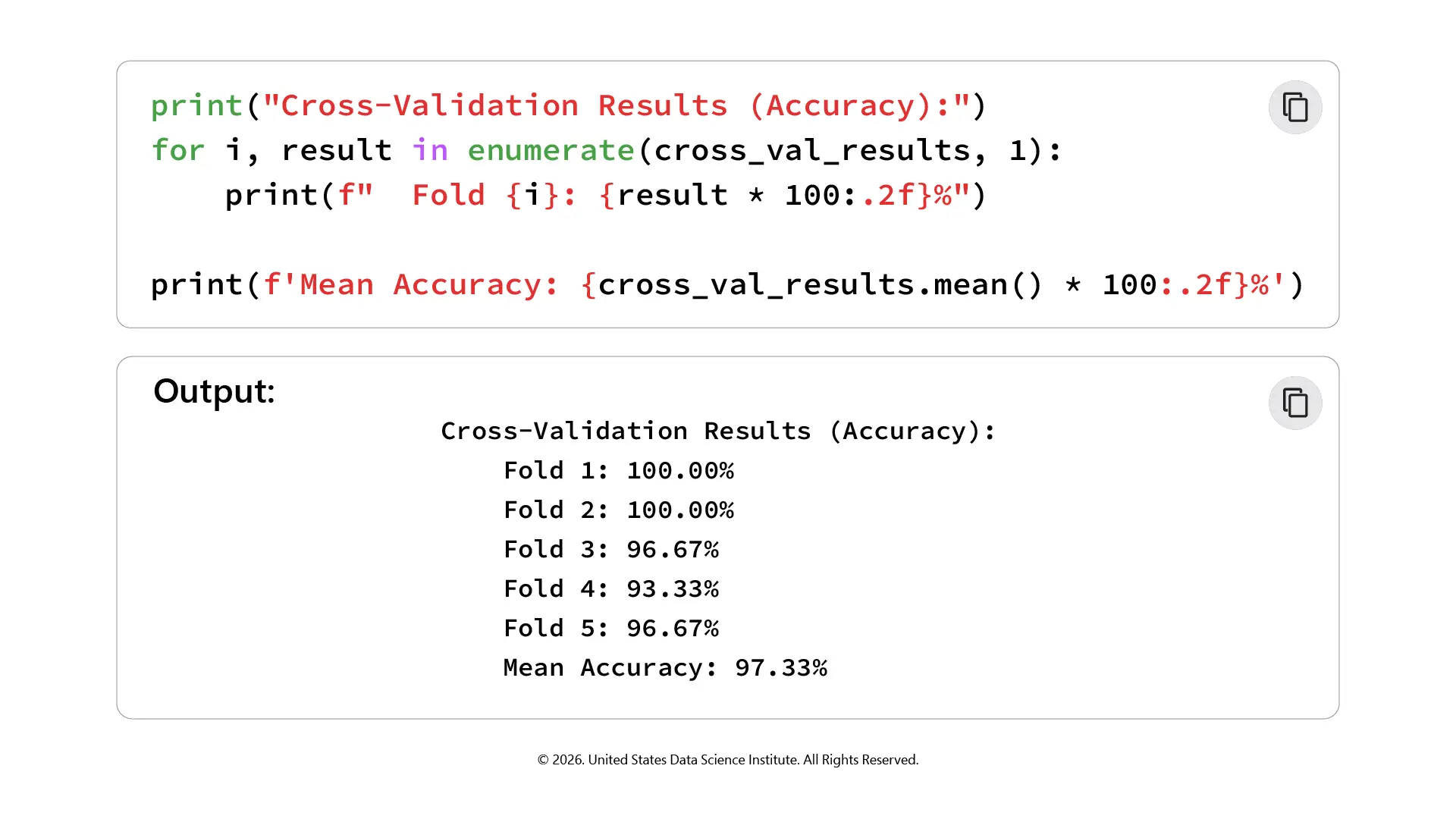
This gives the five separate scores regarding the folds with an accuracy above 90%. The meaning of this statistic is that it really shows the estimated quality of how the model will predict previously unseen data.
Source: GeeksforGeeks
Where Cross Validation Results Go Wrong
A handful of mistakes consistently undermine cross-validation's reliability, as listed below.
How to Upskill for Advanced Machine Learning Work
A comprehensive understanding of cross validation is just one component of a broad skillset that distinguishes professionals who develop dependable models from those who build models that only appear to be reliable during development. There are several areas that often matter most when it comes to building upon that foundation:
Developing this level of technical judgment is what USDSI's data science certifications are designed to support, spanning advanced machine learning, deep learning, and the kind of applied expertise that carries a professional beyond foundational data science work.
Closing the Gap Between Testing and Trust
As models evolve and become involved in making critical decisions, such as in hiring, lending, and medical triage, the impact of an incorrect estimate of model performance goes from being a technical detail to real trouble. While models that apply a robust cross-validation method in their assessment are more likely to identify a faulty model before implementation instead of after it has already produced important results.
FAQs
Can cross validation be used for hyperparameter tuning as well as model evaluation?
Yes, cross validation is commonly combined with grid search or random search specifically to tune hyperparameters while avoiding overfitting to a single validation set.
Is nested cross-validation different from standard cross-validation?
Yes, nested cross validation adds an outer loop specifically for unbiased performance estimation while an inner loop handles hyperparameter tuning separately.
Can cross validation be used with deep learning models, or is it mainly for traditional ML?
It can be used with deep learning, though the computational cost of retraining a large model multiple times often makes it less practical than for simpler models.
This website uses cookies to enhance website functionalities and improve your online experience. By clicking Accept or continue browsing this website, you agree to our use of cookies as outlined in our privacy policy.