Agentic AI is transforming the requirements of “AI-ready data.” Research from S&P Global in 2026 discovered that 52% of the financial institutions surveyed have either already begun to use Agentic AI or moved past the pilot phase. The findings suggest more significant problems, as it is vital that data be both contextual and connected and that agentic AI be able to rely on it.
For data scientists, these changes mean that being ready for agentic AI is not about automating analysis but rather creating proper data through gathering, evaluating, and providing the requisite context. So, what will this shift look like in practice? Here are five Agentic AI trends to watch in 2027.
Trend 1: From Writing Code to Directing Agents
Current: AI is an integral part of data work. According to the 2026 State of Data Engineering Survey, 82% of data professionals say they utilize AI tools on a daily basis or even more often, with 82% of the respondents listing SQL/Python code creation as one of the most frequent usages of AI and 56% mentioning documentation and data discovery.
Looking towards 2027, agents will continue to take over tasks involving coding, querying, and data analysis, and data scientists will spend more time leading and overseeing the work performed by agents.
Trend 2: Automated Data Preparation and Analysis Pipelines
Current: The repetitive nature of data activities, from processing data to analyses, is increasingly being automated by AI technology. Gartner's 2026 studies show that organizations are now focusing on continuous data preparation based on their use cases to prepare data for AI and agentic processes.
Expectations for 2027: Gathering information on data profiling, cleaning, feature preparation, and conducting initial analyses will increasingly be handled by agents, freeing data scientists to give more of their time to deciding what questions should be examined, evaluating the findings, and applying judgment to the results.
Trend 3: Multi-Agent Systems Entering Production Workflows
Current: As opposed to having one general-purpose agent to perform various data science tasks, data science teams are starting to leverage multiple agents with specific purposes, like data retrieval, data validation, modeling, and reporting.
2027 Outlook: Multi-agent workflows will be increasingly a part of production, with clear agent handoffs, shared context, observability, and reliable orchestration. Data scientists will be more frequently partnering with AI engineers to create and oversee these workflows.
Trend 4: Evaluation, Testing, and Governance Becoming Core Work
Current: As AI agents produce more output, human oversight is becoming essential. SmartBear’s 2026 report found that 84% use human review to validate AI-generated tests, while only 3% rely on AI self-validation alone.
2027 Outlook: Evaluation will be a standardized ongoing element of the data science process; automated testing, drift monitoring, approval gates, and governance will be embedded in agentic systems. More emphasis will be placed on the validation of outputs and handling AI reliability by data scientists.
Trend 5: Agentic RAG and the Shift Toward Retrieval-Driven Data Science
Current: With the rise of AI models, data teams are increasingly leveraging RAG as a way to tie those models to enterprise data in order to get more accurate, context-rich analysis, not just based on static training data.
2027 Outlook: Agentic RAG will go further with AI agents being able to retrieve and analyze, validate, and refine information without human input. As AI-driven analytics become more commonplace, data scientists will be more centered on constructing trustworthy retrieval pipelines, assessing context quality, and managing the governance of AI-powered analytics.
How are Data Science Roles Changing?
Agentic AI is redefining responsibilities across data teams faster than it is changing job titles. Routine analysis and pipeline steps now run with far less manual effort, so each position is being organized around building, feeding, directing, or overseeing that automation. Employers are backing the change with pay: Robert Half's 2026 Salary Guide projects a 4.1% starting-salary increase for AI, machine learning, and data science roles.
The table below shows how each role changes by 2027.
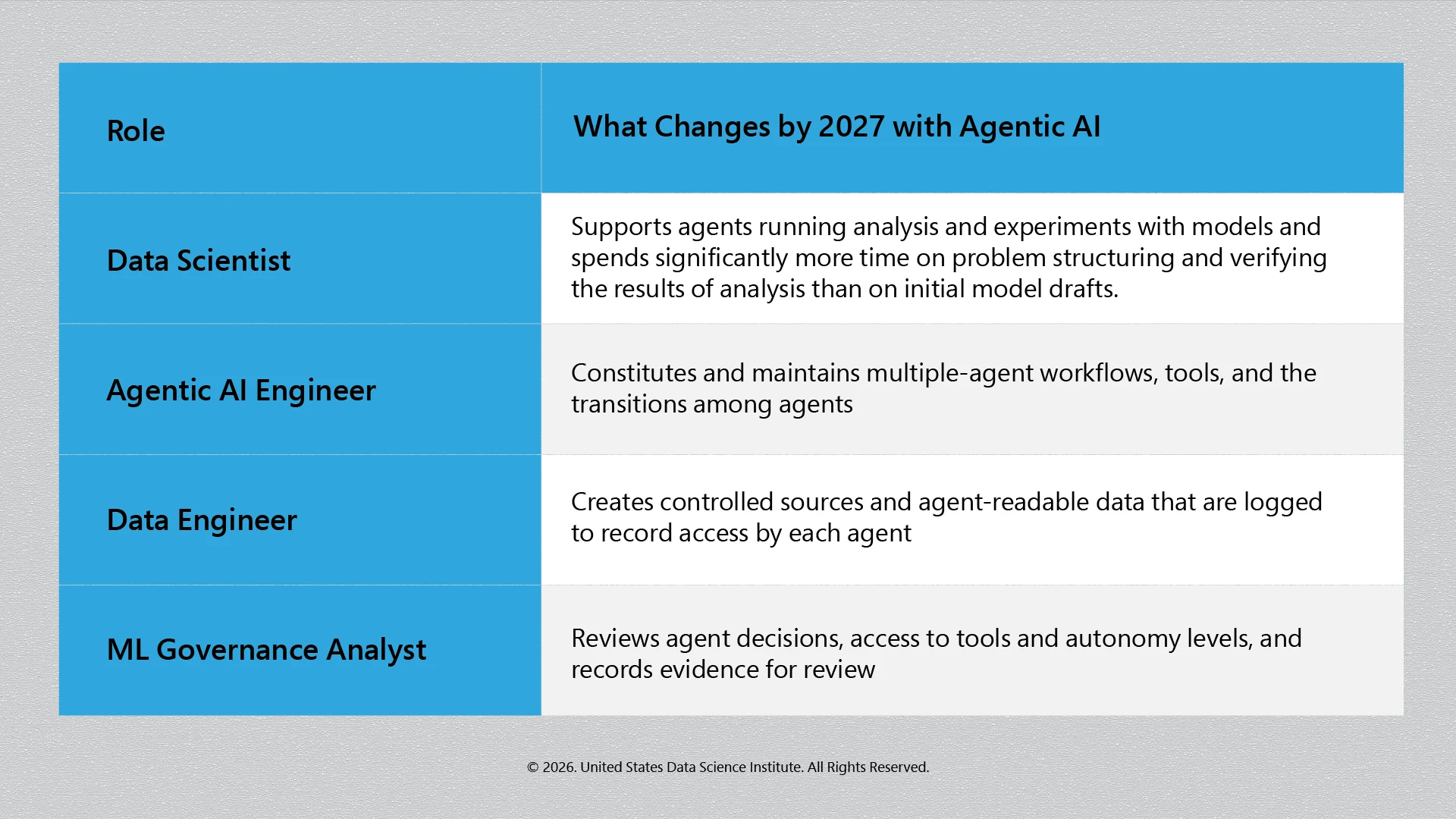
USDSI's AI and Data Science Outlook Beyond 2026 describes how workflows are moving from linear pipelines to orchestrated, AI-augmented execution, with the data scientist's job shifting toward verifying outputs and assumptions.
Skills Worth Building for 2027
The skills that continue to be valuable are those used to manage, monitor, and clarify agent work as they become more responsible for routine execution. The following skills are worth building for future outlook.
Agent task design: Dividing a business problem into tasks an agent can execute reliably, providing clear instructions, and defining stopping points.
Evaluation design: Development of the test sets, scoring rubrics, and drift checks that determine whether or not an agent's product is trusted.
Context engineering for retrieval: Deciding what data, documents, and history are displayed at each stage, which impacts the trustworthiness of RAG-based analytics.
Agent governance: Define what data each agent can access, track lineage of data, and maintain audit logs, teams will be expected to answer what an agent did and why.
Communicating uncertainty: Explaining findings, confidence levels, and limits to stakeholders who will increasingly receive agent-generated answers directly.
How to Upskill for Agentic Data Science Work
Structured data science and AI certifications help because agent-driven work leans on fundamentals that are easy to skip when tools do the typing. The certifications listed below cover that ground.
Pair either certification with a project where an agent runs part of the pipeline and a person signs off on the output.
What Comes Next for Data Science Teams
Agentic AI is likely to become a standard layer across analytics, experimentation, and decision-making processes. Agents will not only be able to perform individual tasks but will also be able to link the various phases of the technical process and work in different data environments.
This might enable data science workflows to be faster and more adaptive and also make it more critical to ensure reliability of data evaluation, clarity of accountability, and well-governed data. For professionals the opportunity is to be able to work effectively with these systems as they become part of their regular analytical routines.
FAQs
Do data scientists need to learn one specific agent framework?
No, frameworks change quickly, so task decomposition, evaluation, and data governance transfer better than any single tool.
How should a team start using agents safely?
Begin with a low-risk, read-only pipeline, require human approval before any write action, and widen scope only after the agent passes evaluation.
Is a coding background required to work with agentic data science tools?
Not always, but reading and testing code remains necessary, since someone must verify what the agent produced.
This website uses cookies to enhance website functionalities and improve your online experience. By clicking Accept or continue browsing this website, you agree to our use of cookies as outlined in our privacy policy.