The scale of AI and data science investment in 2026 is not speculative; it is already being recorded. Gartner expects worldwide AI spending to total $2.59 trillion in 2026, a 47% increase year-over-year, with AI infrastructure accounting for over 45% of that spending and data center systems spending growing 55.8%, surpassing $788 billion, the fastest-growing segment of global IT investment. Understanding what is driving that investment and where it is flowing is what makes the trends covered in this blog more than a technical overview.
Agentic AI: From Tools to Autonomous Action
The most consequential shift in 2026 is the move from AI as a tool to AI as an actor. As USAII® examines in Agentic Engineering: Building the Next Generation of Autonomous Systems, only 11% of organizations have deployed agentic AI systems in production (Deloitte), despite Gartner projecting that 60% of brands will use agentic AI by 2028. Listed below are the developments defining this shift.
Generative AI is Moving from Content to Cognition
Generative AI has outgrown its content creation origins; in 2026 it operates as the reasoning layer across enterprise workflows, generating code, synthesizing research, and powering agentic systems.
IBM's 2026 AI trends analysis identifies three forces defining open-source AI: global model diversification, interoperability as a competitive axis, and hardened governance with transparent data pipelines. Listed below are the key developments shaping its next phase.
Data Science Frontier & Quantum Computing
In 2026, one of the most promising developments for quantum computing is the emerging area of quantum data science, where quantum computing is making a transition from research to early commercial use.
As the USDSI® infographic How Quantum Computers Are Reshaping the Future of Technology in 2026 highlights, quantum computing is already impacting the world's information processing. Listed below are the near-term data science implications.
Evolution of Data Science Workflows
Data science workflows in 2026 are no longer linear; they are orchestrated. The shift from manual, sequential pipelines to AI-augmented, end-to-end execution is changing what data scientists spend their time on and what skills the profession requires.
Listed below are how each stage of the workflow is evolving.
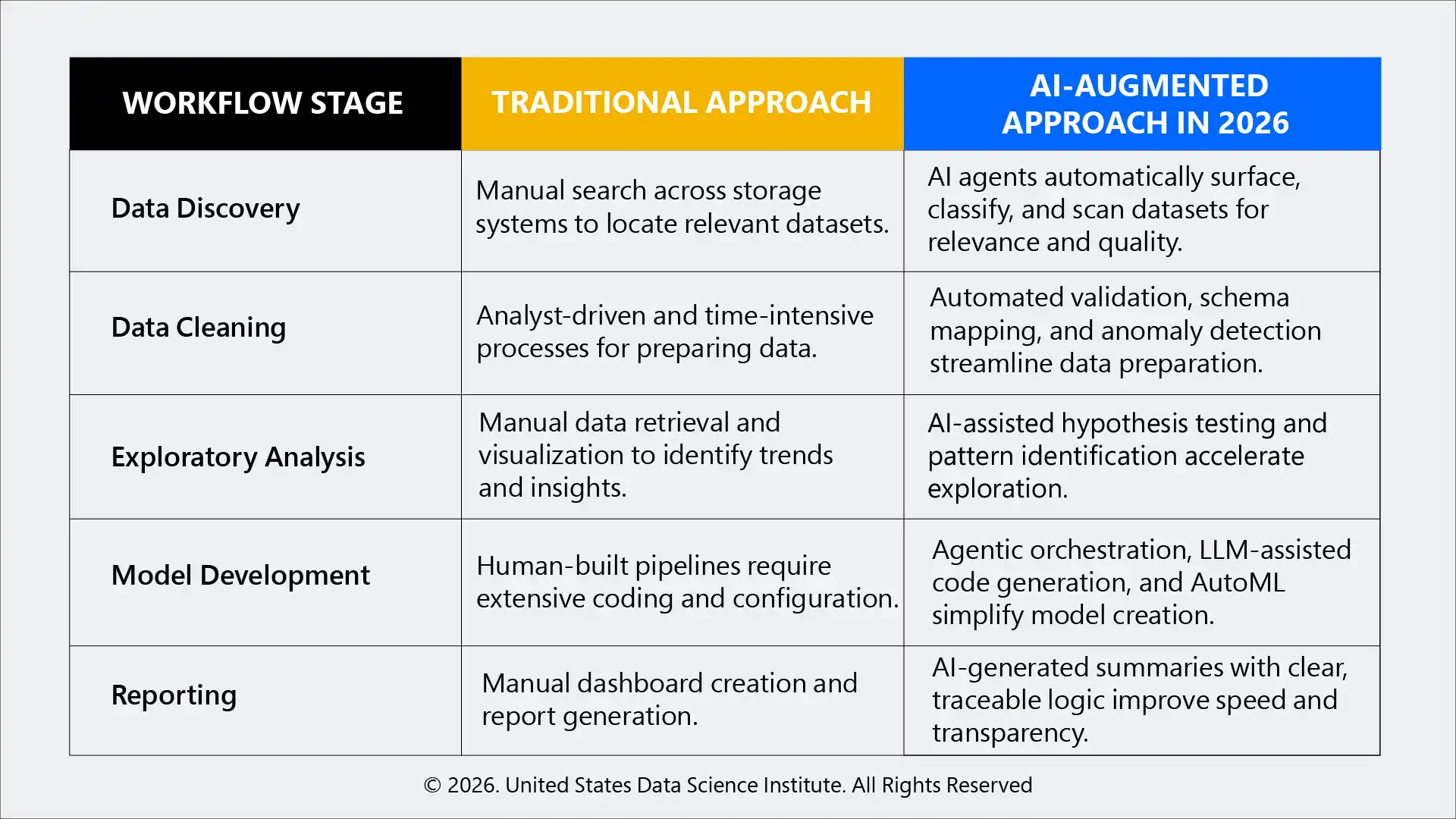
The data scientist's job is moving away from simply running the code to making judgments about the outputs of AI, verifying the model's assumptions, and confirming that the automation is working as per the analytical goals.
Real-Time Analytics and Edge AI
In 2026, edge computing and real-time analytics are becoming business realities and a fundamental requirement. With the event-driven data platform, streaming architectures and low-latency inference are becoming standard features. The following are some of the developments that are driving this transformation.
AI Governance: From Ethics to Enforcement
PwC research finds that 74% of all AI-generated economic value is captured by the 20% of organizations that invest most heavily in governance and responsible AI infrastructure. That makes governance a competitive advantage, not just a compliance requirement. Listed below are the governance developments professionals need to understand in 2026.
Next AI Data Sceinec Wave Beyond 2026
The trends visible in 2026 are early signals of deeper structural changes that will define AI and data science moving ahead, with key shifts focusing on the following:
Verified, high-quality operational data will function as digital currency, powering AI-driven marketplaces and B2B transactions where agents negotiate and execute without human intermediaries.
The organizations of 2030 will not be companies that use AI; they will be companies designed around it, with workflows, roles, and governance frameworks rebuilt with AI orchestration as the default operating model.
The professionals who thrive beyond 2026 will be those who direct AI, evaluate its outputs, and apply the judgment autonomous systems cannot replicate; the most valued professional skill across every sector where AI is deployed.
Opportunity Ahead
The convergence of agentic AI, generative models, quantum computing, real-time analytics, and governance frameworks is creating a profession that looks fundamentally different from what it did years ago. For professionals looking to build and formally validate that competency, USDSI® data science certifications provide a structured, vendor-neutral pathway covering the foundations that 2026 and beyond will demand.
The future of AI and data science is not something that arrives fully formed; it is built by the professionals who invest in understanding it now. Those who pair continuous formal learning with applied practice will not just adapt to what comes next; they will be the ones defining it.
FAQs
How is real-time analytics changing the data science profession in 2026?
Real-time, event-driven pipelines are replacing batch processing, requiring data scientists to design and govern streaming architectures alongside traditional analytical systems.
Which beginner certifications help professionals build competency for the future of AI?
The Certified Artificial Intelligence Engineer (CAIE™) by USAII® equips professionals with the AI engineering and agentic systems expertise needed to thrive in 2026 and beyond.
What job roles are emerging at the intersection of AI and data science in 2026?
AI Data Scientist, Agentic AI Engineer, ML Governance Analyst, and AI Product Strategist are among the fastest-growing roles at the convergence of AI and data science.
This website uses cookies to enhance website functionalities and improve your online experience. By clicking Accept or continue browsing this website, you agree to our use of cookies as outlined in our privacy policy.