Data science teams can create business value by turning data into insights. A considerable amount of time is spent by data science teams on various data science tasks, such as data cleaning, query writing, documentation, reporting, and more, in order to provide insights.
Generative AI is helping the automation of these tasks, allowing teams to focus more on analysis and decision-making. As organizations grow more reliant on AI, investments are being continued. Gartner predicts global AI spending will grow to $2.59 trillion by 2026, highlighting the value of AI-powered technologies in business and analytics processes.
Traditional Data Science Workflow
A typical data science project involves multiple stages before insights can be delivered to stakeholders.
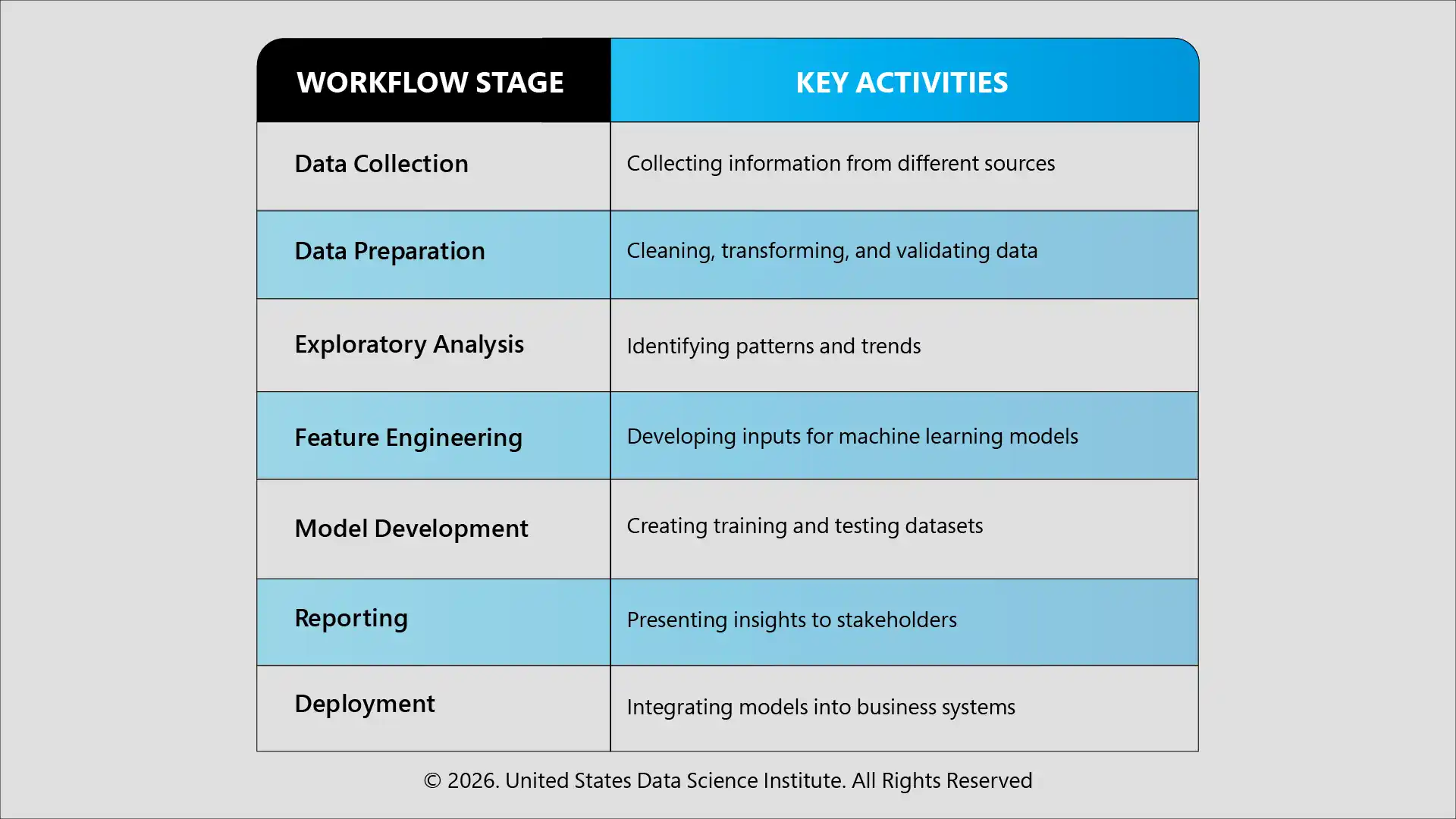
How Does Generative AI Fit in the Data Science Workflow
By automating tasks performed by data scientists and providing relevant suggestions in workflow, Generative AI provides support to data scientists in:
This will free up data teams to do more analysis and decision-making rather than repeating operational tasks.
1. Transforming Data Preparation and Data Cleaning
Data preparation is typically the most time-intensive aspect of the data science process. Generative AI can assist in
Data scientists can use natural language requests to create code quickly rather than having to repeatedly write the same code. This reduces the duration of each project and provides consistent results.
2. Making Data Exploration More Accessible with Natural Language Queries
Historically, data access using SQL, Python, or BI tools was an expert-level task. With generative AI, this becomes easy by using natural language queries.
For instance, users could type, “Which customer segments contributed the most to revenue growth in the past six months?” and generative AI could
This helps both the data team and users get to more valuable analytical tasks quicker.
3. Accelerating Feature Engineering
The performance of a machine learning model depends heavily on feature engineering; however, this often requires much experimentation.
Generative Artificial Intelligence can help
These recommendations will speed up development time and allow data scientists to analyze more options, particularly when dealing with larger and changing data sets.
4. Streamlining Model Development and Experimentation
Testing and tuning several algorithms and measuring their performance is frequently an aspect of model development.
The use of generative AI can speed up this process with
Data scientists can utilise AI-generated frameworks as a method of constructing the base for their model and will be able to focus on refining parts.
5. Improving Documentation and Reporting
While documentation plays an essential role in collaboration, governance, and sustainability of any project, it is often neglected or poorly done.
Generative AI can generate
Additionally, it provides support to convert technological findings into a clear narrative and produce reports for stakeholders.
It provides a mechanism for all organizations to maintain knowledge from one project to another, which is important to help organizations effectively scale their analytics efforts.
Business Benefits of GenAI in Data Science
The benefits of Generative AI go beyond boosting productivity for individual data scientists. Organizations are learning that they are getting a return on their investments in terms of wider business benefits, such as:
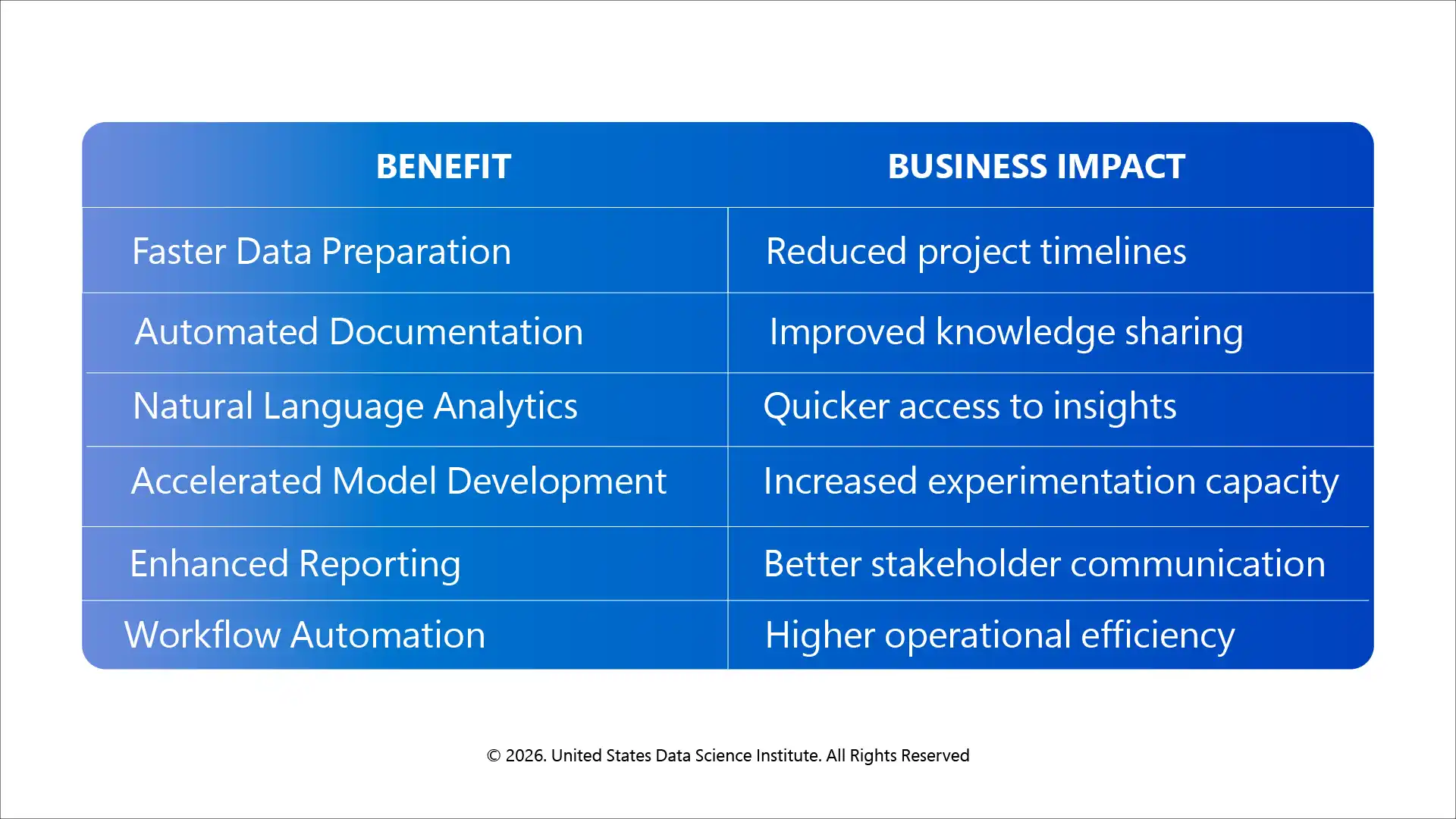
As highlighted in USAII® insight "Top Emerging Technologies Shaping 2026 and Beyond" Generative AI is increasingly converging with intelligent automation, advanced analytics, and agentic systems to improve enterprise productivity. Organizations are no longer evaluating AI solely as an innovation initiative. The future of data science is based on improving efficiency, scalability, and business outcomes.
What Generative AI Cannot Replace
Despite the growing capability, generative AI is not enough to manage an end-to-end data science project without assistance from a human being.
The following tasks will still require human expertise:
In order for companies to be successful, it is required to use a collaborative model where AI performs repetitive tasks and data experts execute business solutions.
Future Skills of AI-Assisted Data Science
As the integration of Generative AI in analytics workflows progresses, data professionals require new skills. Key emerging areas of demand include:
To assist with developing these capabilities, USDSI® Data Science Certifications offer structured programs built around applied, industry-relevant skills in modern data science, including AI-integrated workflows.
Through technology functionality such as automated creation of data as well as automated generation of features, increased speeds can occur in model creation and reporting, as well as decreased friction during each of the phases of the entire data science workflow.
FAQs
Can Generative AI create machine learning models automatically?
Yes, it can generate model code and suggest algorithms, but human validation is still necessary.
Does Generative AI reduce the need for SQL skills?
Not entirely; it simplifies data access through natural language queries, but SQL remains valuable for advanced analytics.
Which industries benefit the most from Generative AI in data science?
Finance, healthcare, retail, manufacturing, and technology sectors are among the leading adopters, exuding massive demand for skilled data science professionals as well
This website uses cookies to enhance website functionalities and improve your online experience. By clicking Accept or continue browsing this website, you agree to our use of cookies as outlined in our privacy policy.