Generative AI is no longer limited to question-and-answer techniques and has now evolved into AI agents capable of planning and reasoning through several steps. McKinsey’s survey on the State of AI indicates that in 2026, 40% of large organizations have indicated implementing AI agents, an increase from 27% previously reported in 2025. The ever-changing world of AI has allowed businesses to explore Retrieval-Augmented Generation (RAG) methods, creating a new form of RAG called Agentic RAG.
This blog demonstrates how Agentic RAG can work, how it differs from traditional RAG, what its main components are, where they can be applied, and what main aspects need to be taken into account when using it.
What is Retrieval-Augmented Generation (RAG)?
RAG uses relevant information from documents within an organization as input for a language model to support it in providing responses. This avoids hallucination and ensures responses are grounded in the actual source material, a common structure for enterprise question answering.
RAG is a structured approach that consists of three steps:
1) Question or a query
2) Most relevant documents retrieval
3) Response generation based on the retrieved documents
This is executed one query at a time, and there is no provision to fine-tune the search if the initial retrieval is not satisfactory.
What is Agentic RAG?
Agentic RAG adds an AI agent to the retrieval process so that the system itself can reason about what it requires, decide how to find it, and assess whether its outcomes are satisfactory before generating a response. In contrast to making retrieval merely a step, agentic RAG treats it as a task to be managed by the agent so that it can take whatever approach it wishes to complete it.
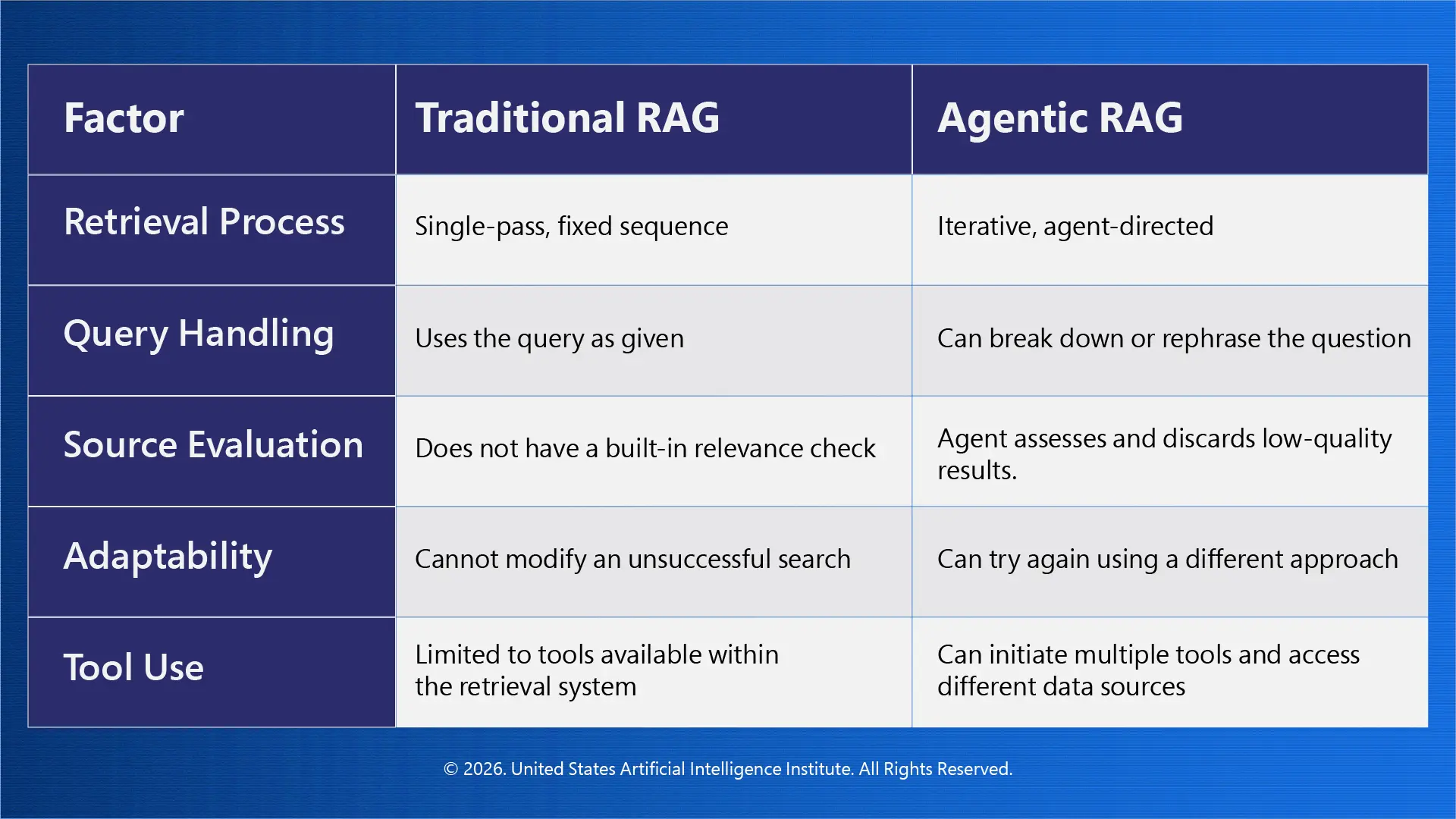
How Agentic RAG Differs From Traditional RAG
The two architectures are different at almost every stage of the retrieval process, not only in how they deal with a single step. The table below shows precisely where those differences lie.
AI Agents For Retrieval Enhancement
An agent does not just retrieve information once and stop; it actively shapes how that retrieval unfolds, step by step:
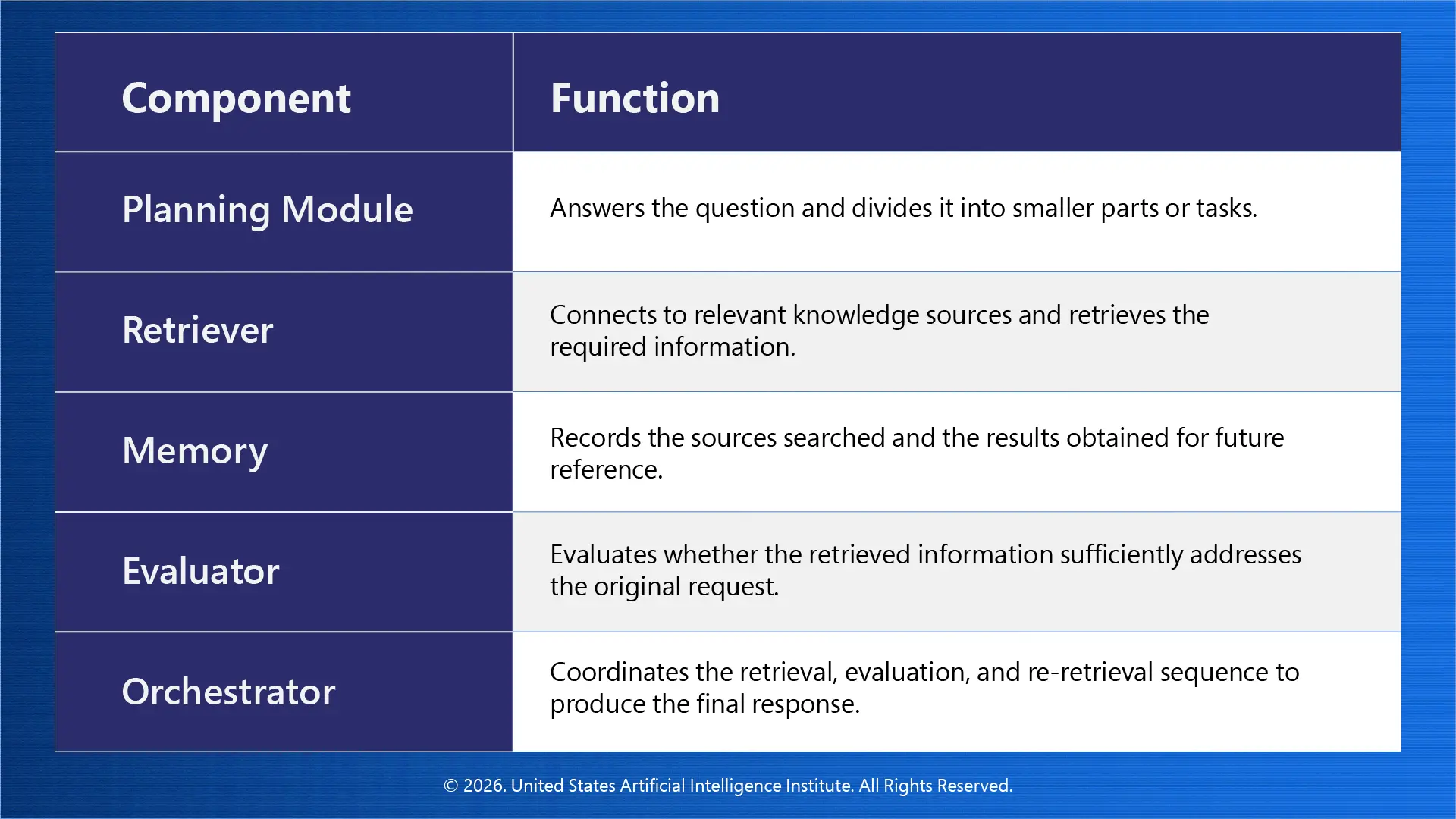
Key Components of an Agentic RAG System
Building an agentic RAG system relies on the cooperation of a number of components, each handling a specific part of the reasoning process:
USAII's Agentic Engineering: Building the Next Generation of Autonomous Systems goes deeper into the architectural patterns behind systems like this, covering how autonomous components are designed, tested, and deployed responsibly at scale.
Real-World Applications of Agentic RAG
Agentic RAG tends to deliver the clearest value in settings where a single retrieval pass genuinely cannot cover the ground a question requires:
Challenges and Limitations
The advantages of Agentic RAG also come with significant challenges, which can be classified into the following categories:
Building Agentic RAG Expertise Through Data Science Certification
To work with these types of systems, one must be proficient in big data infrastructure and machine learning, natural language processing, and cloud deployment at the same time, not one of these separately. USDSI's Certified Lead Data Scientist (CLDS™) is designed for individuals who are already well trained in core data science concepts and need to take their skills to the next level to build more complex, production-ready systems, working with big data, advanced machine learning and deep learning, NLP, and cloud strategy.
USAII's AI certification CAIE™ provides further structured pathways for professionals building the technical AI engineering side of these systems, specifically applied machine learning and generative AI development.
Conclusion
Agentic RAG is a notable improvement beyond conventional retrieval, providing AI systems with the ability to reflect on their retrieval efforts rather than just implementing them. This ability inflicts real drawbacks in terms of complexity and cost, meaning it should be employed only in situations when one retrieval attempt is actually not enough and not in every situation. Those organizations that are building their technical base now and taking efforts to see how such systems develop will be able to gain real benefits from using such systems.
FAQs
Can agentic RAG be built using existing RAG infrastructure?
Yes, many organizations extend an existing RAG pipeline by adding a planning and evaluation layer on top, rather than replacing the retrieval system entirely.
Is agentic RAG the same as a general-purpose AI agent?
No, agentic RAG applies agentic reasoning specifically to the retrieval process, while a general-purpose AI agent may handle a much broader range of tasks beyond information retrieval alone.
Do data scientists need to learn agentic RAG, or is this primarily an engineering skill?
Both benefit from understanding it, though the actual system-building work tends to fall more on data scientists and AI engineers with strong technical implementation skills.
This website uses cookies to enhance website functionalities and improve your online experience. By clicking Accept or continue browsing this website, you agree to our use of cookies as outlined in our privacy policy.