
Enterprise decision-making has changed fundamentally. Data volumes have grown beyond what traditional analyst workflows can process, and the margin for delayed or uninformed decisions is shrinking across every sector. According to Alteryx's 2026 State of the Data Analyst report, 85% of analysts now report that AI-generated insights influence business-critical decisions at their organization.
That figure signals a structural shift in the future of data analytics, not a trend. AI data analysts are no longer peripheral to the decision chain; they are at the center of it. Let us explore what that actually looks like in practice across modern enterprises.
Responsibilities of an AI Data Analyst
An AI data analyst combines traditional analytical competencies with the ability to work alongside and interpret outputs from AI and machine learning systems. The role is defined by the breadth of the pipeline the analyst can navigate, not by a single tool or technique.
Core responsibilities include:
The average salary for an AI Data Analyst in the United States is $131,196 per year, as indicated by Glassdoor, which has a median range from $109,839 to $159,245 annually.
AI Data Analysts and the Enterprise Decision Structure
In most large organizations, decisions pass through three layers that are operational, tactical, and strategic, and AI data analysts operate across all of them.
That range of responsibility places direct demand on professionals who can manage AI deployment at scale without losing governance or interpretive accuracy.
Data Foundations for AI Analysts
AI data analysts cannot produce reliable outputs from an unreliable data foundation. The quality of every prediction, recommendation, or decision support traces back to how data is stored, governed, and made accessible.
As highlighted in Top 5 AI and Data Science Trends to Watch in 2026, the organizations leading in AI-driven analytics are those that have invested in the infrastructure beneath the model layer, not just the models themselves.
This is a list of key requirements for an effective AI analyst, based on a data foundation.
AI Data Analysts for Business Value Creation
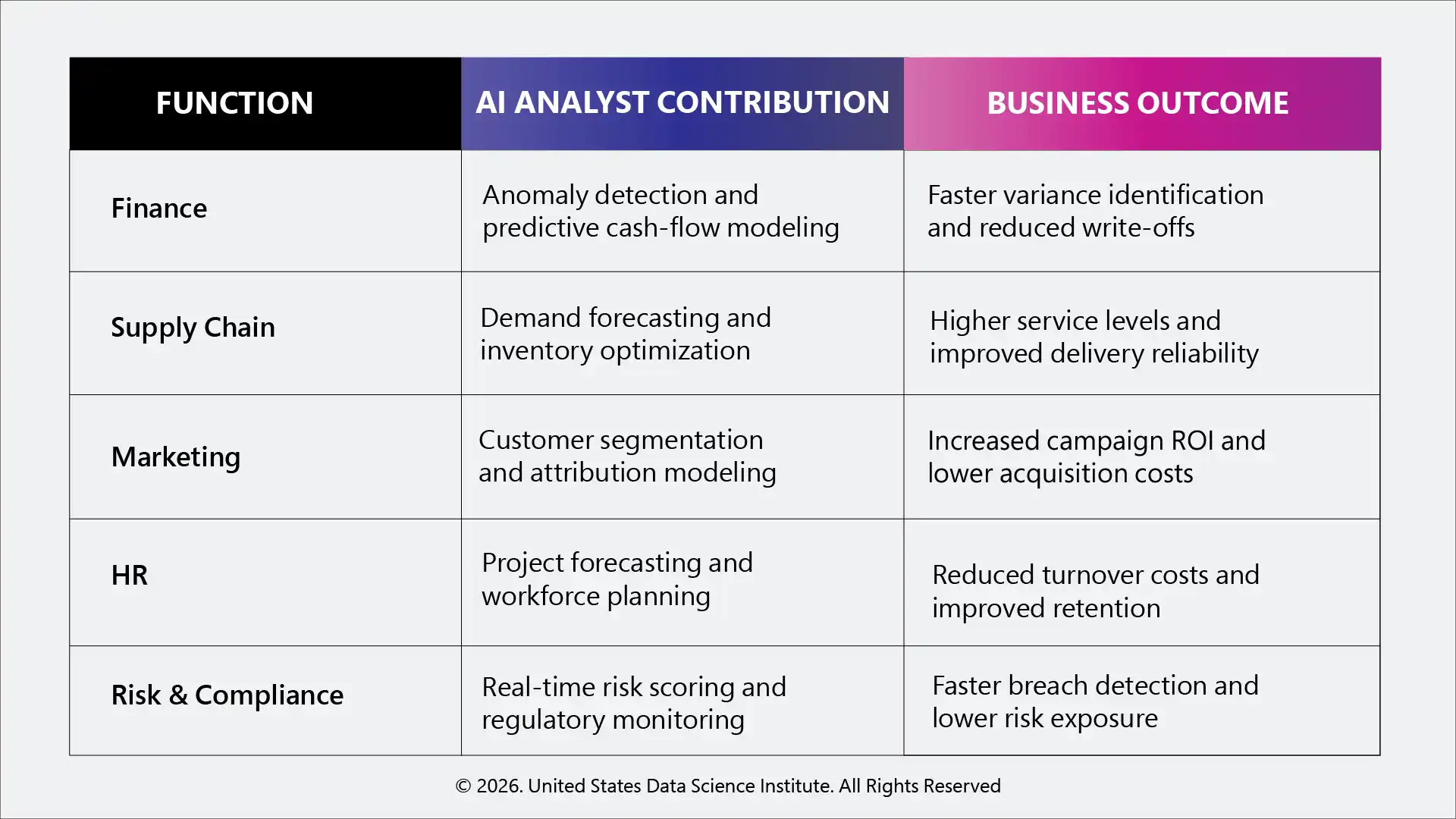
The business case for AI data analysts is not theoretical. Their impact is measurable across functions when the right data infrastructure supports their work. The table below outlines where that value is most concentrated.
AI Data Analyst Skills
The technical dimension of the role is well-documented. Python, SQL, machine-learning frameworks, and data visualization tools are baseline expectations. What separates effective analysts in enterprise environments is what sits above those technical skills.
As USAII® has explored in Will AI Transformation Replace or Evolve Jobs?, the trajectory for AI analytical roles is one of evolution, not elimination, with the most valuable professionals being those who can work alongside AI systems while maintaining the judgment those systems cannot replicate.
How to Upskill for an AI Data Analyst Role
Bridging that gap requires more than tool familiarity; it requires structured competency in statistical modeling, data pipeline management, machine learning interpretation, and business communication.
For professionals looking to build and formally validate those skills, USDSI® data science certifications offer a structured, vendor-neutral framework that covers the analytical and technical depth enterprise AI data analyst roles demand.
The professionals who will define enterprise AI outcomes are not those who build the most sophisticated models; they are those who know how to make those models useful, trustworthy, and actionable for the business.
For professionals in data and analytics, the direction is clear: develop the full-pipeline competency, build governance discipline, and close the gap between analytical output and business judgment. That combination is what the market is rewarding in 2026.
FAQs
Which industries are hiring AI data analysts at the highest rate in 2026?
Financial services, healthcare, retail, and technology are currently the highest-demand sectors for AI data analyst roles.
How is the AI data analyst role different from a machine learning engineer?
Machine learning engineers build and deploy models, while AI data analysts interpret model outputs, validate their reliability, and translate insights into business recommendations.
What tools do AI data analysts most commonly use in enterprise environments? Python, SQL, Power BI, Tableau, and cloud-based platforms such as Databricks and Snowflake are among the most commonly used tools in enterprise AI analyst workflows.
This website uses cookies to enhance website functionalities and improve your online experience. By clicking Accept or continue browsing this website, you agree to our use of cookies as outlined in our privacy policy.