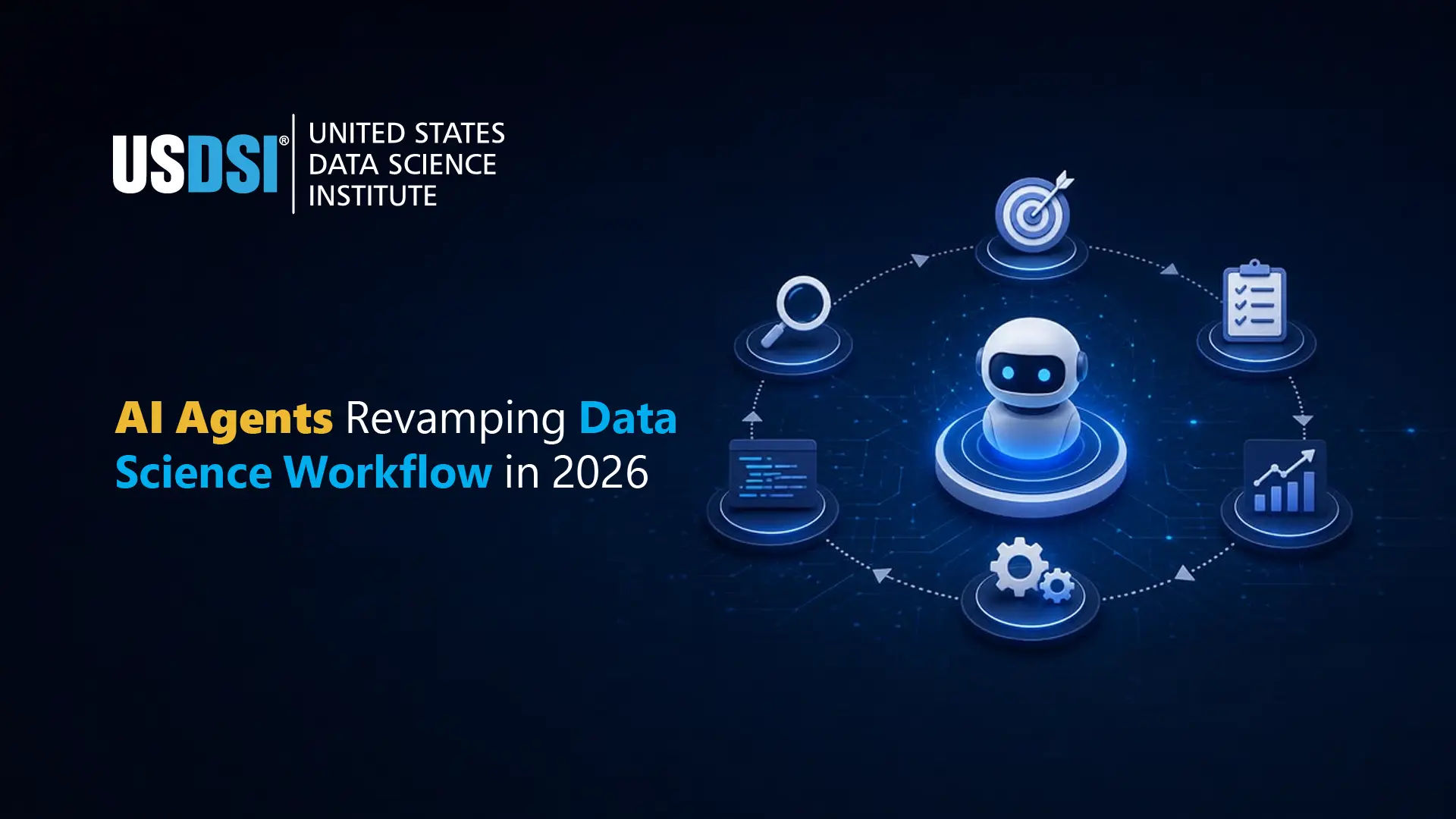
Picture this: A data scientist types a question in plain English, and an AI system goes off and does the work sitting behind it. That is not a future scenario anymore. AI Agents are already pulling Data Science away from one-off prompts and toward goal-oriented workflows.
A case study in the Google Cloud AI Agent Trends 2026 report stuck with us. As per the report, Suzano, a global pulp manufacturer, used an AI agent to turn natural-language questions into SQL queries against its SAP data. The report puts a reduction in query time of 95% across a workforce of 50,000.
That is what makes Data Science Work in 2026 different. The agent is not just writing code. It ties the question, the data, the analysis, and the action together, and it does that without taking direction or judgment away from the person running the project.
Data Science is Moving from Tasks to Workflows
Think about how the job actually runs today. A data scientist finds the data set, writes the query, filters the rows, hunts for patterns, builds a model, reads the results, and then explains what all of it means to someone else. One task after another.
AI Agents change how those tasks hang together. Instead of walking through every step alone, you set the objective and let an agent coordinate several steps toward it.
Today, agentic systems are the ones that interpret goals, generate plans, take action inside apps, and stay under human guidance and supervision. That opens the door to a different kind of question.
Compare "Write SQL for customer churn" with "Investigate why customer churn increased this quarter." The first one is code. The second needs data discovery, analysis, comparison, and interpretation. The broader the goal, the more places an agent can be useful.
Agents Taking Over the Mundane
Replacing the entire data science workflow is not the opportunity here. The opportunity is handing agents the repetitive stretches so data scientists can spend their hours on decisions that need judgment.
Where agents fit:
None of these are especially impressive on their own. The value shows up when they run together. The data scientist stops coordinating repetitive work and starts asking what the work actually means. That points to something bigger: several agents working on one analytical workflow at the same time.
Agentic Assembly Line
Imagine a line of production stations, but each station is an AI agent, and a human person is at the far end who decides whether the product will be shipped or not. This is the direction that a lot of data science work is going in 2026.
In fact, data science lends itself to this arrangement. Projects already have their phases, and it isn't impossible to give each phase to its own agent. One gets the data ready, one does the exploratory analysis, one constructs the model, and one writes it up. When arranged in sequence, the business question is on the left, and deployment and monitoring are on the right; you have a data science workflow.
The number of agents involved really isn't that important. It's the middle checkpoint, the human review, that's important. That's what keeps this kind of automation from going unwatched. Yes, agents can do more of the work, but somebody still has to review the output and decide whether it is right, reasonable, and useful. As these pipelines move out of the lab and into the real world, that supervision has to move with them, not stay behind.
Agentic AI Is Already in Production
AI Agents in 2026 are no longer just a novelty; it is production. These systems are being put to the test in actual company environments, not just in a demo. This changes the question teams are asking. It is no longer about “can an agent do this”; rather, it is about “should it.”
Once an agent can touch enterprise data or take actions within enterprise systems, a whole list of mundane things suddenly becomes important.
Technical capability alone isn't going to decide who wins here. A professional is still required to give it direction and ensure that it's on the right track, and that's still the data scientist's responsibility.
Skills That Matter Today
The skill that is gaining importance now is how to manage execution and how to assess and keep AI-assisted work in check. Python, SQL, statistics, and machine learning models aren't eliminated. You need that grounding even more, because it's how you stand up to what an agent hands you. Surveys generally agree that skills across the profession are changing rapidly, and technical skills are changing fastest of all.
Here's where it is worth putting your energy!
Statistical reasoning to tell true results apart from random noise.
Problem framing, taking a "business ask" and making it measurable.
Delegation, knowing which tasks go to which systems or agents.
Spotting the unstated assumptions holding up a conclusion.
Right communication to make sure the output reaches a decision maker intact, without distortion or lost meaning.
Knowing how to write a good prompt is not the edge anymore. Plenty of professionals can already do that. The real flex is knowing what to hand off, how to check it, and when to stop trusting the agent and go with your own judgment. It's also the difference between someone who has adopted AI and someone who is actually getting something out of it.
Future Forward
As of now, no serious voices are claiming that AI agents will replace data scientists. It's too early to make that call. The real test is how well people combine their own judgment with what machines can execute. Agents will handle more of the preparation, analysis, experiments, and monitoring. What stays with the data scientist is everything else: asking the right questions, verifying the evidence, and making the final decision. Stay curious and keep upskilling to stay relevant in the AI era!
Frequently Asked Questions
Yes. Due to the proliferation of data, the need for data professionals is increasing day by day to transform data into meaningful business insights.
Today, AI is used to automate many routine tasks of data scientists, so that they can properly focus on insights and business problems. It reduces data scientists' workload, increases their productivity, and saves their time for important tasks.
Build your AI and data science skills with globally recognized certifications from USAII® and USDSI®. These vendor-neutral and graded credentials suit students and professionals across experience levels, from beginner to leadership-focused programs.
This website uses cookies to enhance website functionalities and improve your online experience. By clicking Accept or continue browsing this website, you agree to our use of cookies as outlined in our privacy policy.