The way AI systems collaborate is changing. For years, agentic AI meant deploying a single agent to handle a defined task within one system, one workflow, and one boundary. That model is no longer sufficient for the complexity organizations are operating at in 2026. Multi-agent systems are the fastest-growing segment of an agentic AI market estimated to reach $9.89 billion in 2026 and projected to grow at a 43.50% CAGR through 2031, as per Mordor Intelligence.
The shift is structural, from isolated agents executing tasks to coordinated networks collaborating across systems, organizations, and physical environments. What that collaboration looks like today, where it is heading, and what it means for professionals building on top of it is what this blog covers.
What are Multi-Agent Systems
A multi-agent system (MAS) is an architecture in which multiple AI agents, each with defined specialization, memory, and tool access, operate in coordination to accomplish shared objectives.
Rather than one agent handling a task end to end, a MAS distributes work across agents that reason independently and communicate with each other, with an orchestration layer managing task sequencing, communication, and conflict resolution across the system.
Why is Single-Agent Architecture not Enough
Single-Agent AI was always a transitional design. As workflows grow in complexity, the structural limits of handling everything through a single agent become impossible to work around.
Multi-agent systems address each of these through specialization, parallelism, and inter-agent verification.
How Multi-Agent Systems Work
To understand MAS collaboration in practice, consider a procurement workflow: an inventory agent detects low stock, triggers a procurement agent to evaluate contracts, a supplier agent contacts vendors, a compliance agent checks approvals, a logistics agent schedules delivery, and a reporting agent closes the audit trail, all without human routing.
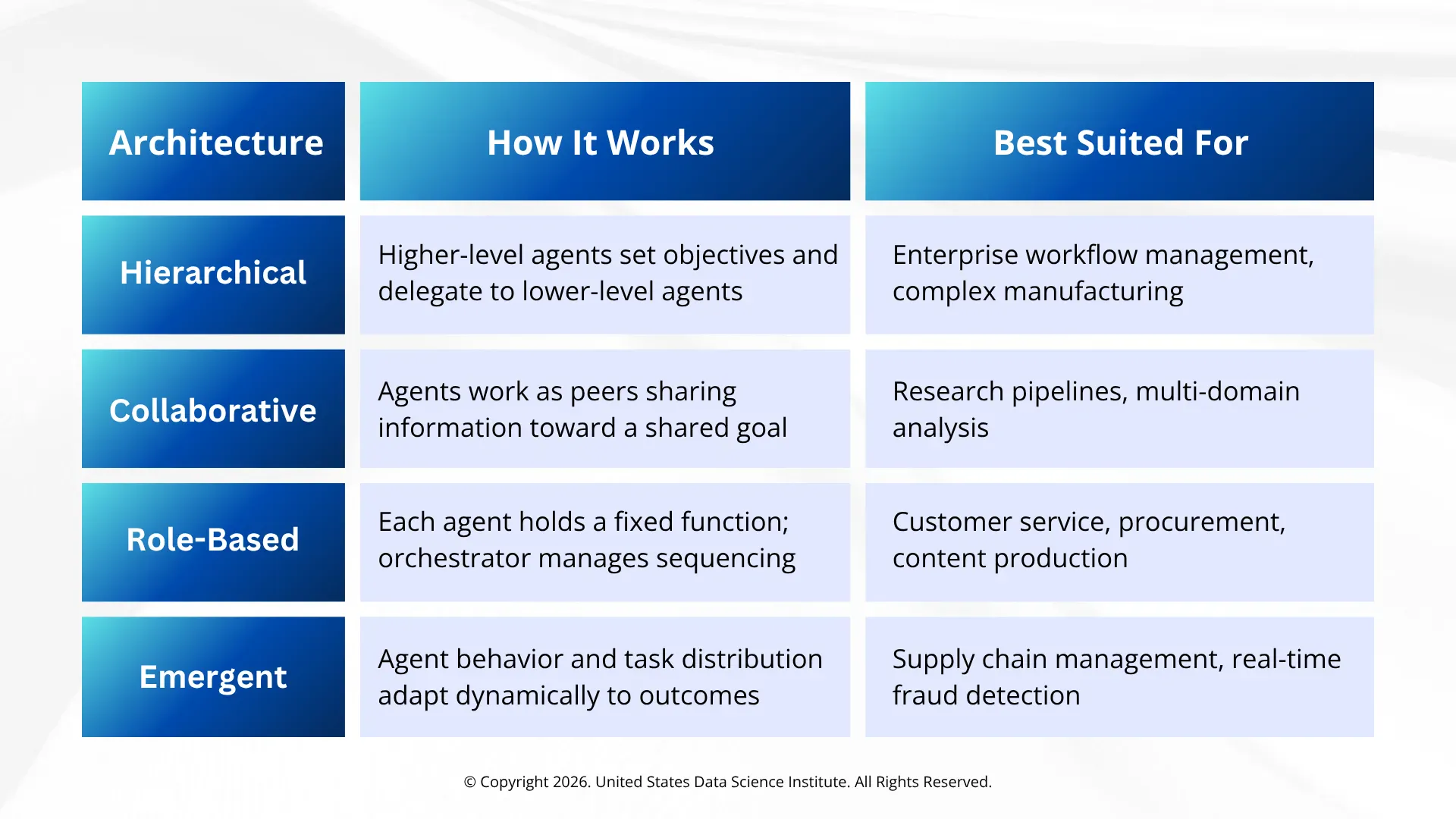
The table below maps the primary MAS architectural models to their real-world applications.
Data Foundation MAS Depends On
As the USDSI® insight How AI Reinvents the Modern Data Science Workflow: Beyond Code Generation highlights, AI now orchestrates work across entire data stacks, from pipeline automation and cleaning through to analysis and reporting.
For MAS, that foundation matters directly: errors that compound silently in a single-agent workflow propagate far faster across a network of agents drawing from the same data infrastructure. Production MAS deployments require:
Where Multi-Agent Collaboration Is Headed
This is where the architectural shift becomes a structural transformation in how agentic AI systems collaborate, not just within a single organization, but across systems and physical environments. Listed below are key trends:
Protocol Standardization
MCP and A2A communication standards are creating the infrastructure for agents from different systems and organizations to collaborate reliably, expanding agentic AI collaboration from within-enterprise workflows to cross-organizational networks.
These standards are especially significant for natural language processing-driven agents, enabling context-aware message exchange across systems without custom integration at each connection point.
Self-Improving Agent Loops
Future MAS will incorporate agents that evaluate their own collaboration patterns and adjust based on outcome data, enabling agent networks that improve their collective performance continuously without human reconfiguration.
Agent-Generated Agents
Orchestrator agents will generate and deploy specialized sub-agents on demand, making collaboration networks dynamic and self-assembling rather than statically configured for each new task.
Convergence With Physical Systems
Agentic AI collaboration is extending beyond digital environments, integrating with robotics, IoT sensors, and edge devices to create hybrid networks where software and physical agents coordinate in real time across manufacturing, logistics, and healthcare environments.
From Task Automation To Collaborative Intelligence
The most significant future shift MAS enables is not operational efficiency; it is the replication of human team dynamics at scale. MAS replicates the coordination, specialization, and escalation logic of entire working teams, with human professionals shifting from execution to orchestration, governance, and exception handling.
As USAII® highlights in Agentic Engineering: Building the Next Generation of Autonomous Systems, effective agentic engineering requires governance, human-in-the-loop design, and security guardrails from the outset, because in a MAS, that discipline is what separates deployments that scale from those that fail. The organizations that get this right will operate with a level of coordinated intelligence that no single-agent system or human team working alone could replicate.
Governance and Trust: Future Forward Infrastructure
According to Deloitte's 2026 State of AI in the Enterprise report, only 21% of organizations currently have a mature model for agent governance in place, and multi-agent systems raise the governance stakes significantly. The points below outline where that governance gap is most consequential for MAS deployments.
Conquering the Next Move
Multi-agent systems represent the most consequential shift in agentic AI collaboration since the introduction of large language models. The professionals who invest in understanding MAS design, data infrastructure, and governance now are the ones who will lead as this architecture becomes the default rather than the exception.
For professionals building that competency formally, USDSI® data science certifications cover the data infrastructure and analytical foundations that production MAS deployments depend on, while USAII® AI certifications provide the AI engineering and agentic system knowledge required to design, deploy, and govern multi-agent architectures at enterprise scale. Start your learning journey today.
This website uses cookies to enhance website functionalities and improve your online experience. By clicking Accept or continue browsing this website, you agree to our use of cookies as outlined in our privacy policy.