Healthcare produces more data than almost any other industry, and making all that data clinically useful is one of the challenges facing the healthcare industry. NVIDIA's State of AI in Healthcare and Life Sciences: 2026 Trends survey revealed that data analytics and data science are among the most widely used AI workloads across the healthcare industry, with 65% of healthcare organizations currently applying the technology for this purpose.
MarketsandMarkets' 2026 Healthcare Analytics Market Report corroborates that movement with actual investment figures, predicting that the global healthcare analytics market will expand from $69.74 billion in 2026 to $213.27 billion by 2031, with a 25.1% CAGR. All those numbers represent real, specific issues being addressed. Let us discuss the real challenges data science is dealing with in healthcare and powering smart decisions.
Data Science for Healthcare's Biggest Challenges
A few specific problem areas illustrate where data science is making a measurable difference.
Early Disease Detection and Diagnosis
Using machine learning models based on medical imaging and patient information, patterns that are difficult to detect by the human eye can be identified, especially for early cancer detection and cardiovascular risk screening. Early diagnosis is always the best time to diagnose and treat disease, and it reduces the cost of long-term care.
Personalized Treatment and Patient Care
Instead of standard treatment protocols for all patients, data science allows for treatment plans to be personalized based on each patient's genetic information, medical history, and actual health data. This method, sometimes known as precision medicine, is changing the way diseases, such as cancer and chronic diseases, are treated.
Predictive Healthcare and Risk Assessment
When patient data is used to predict which patients are at risk of hospital readmission, sepsis, or other acute conditions before these conditions are actually experienced, the care team will have a window to act before they need to react.
Drug Discovery and Medical Research
In the past, years were required to take pharmaceutical research from early discovery to clinical trials. With the ability to identify compounds that are worth investigating and to predict their effects, data science can help shorten the process, cutting development costs and speeding up the time to market for new therapeutics.
Hospital Operations and Resource Management
In addition to patient care, data science also plays a crucial role in the day-to-day functioning of healthcare systems, such as foreseeing patient loads, optimizing staffing, and managing medical equipment and pharmacies more efficiently.
Role of AI and Machine Learning in Healthcare Data
Most data applications in the healthcare industry today are built with AI and ML at their core. Natural Language Processing (NLP) is the science of gaining structured insights from unstructured clinical notes. A computer vision model can point out abnormalities in scans, aiding radiology and pathology. Instead of using a single static model to predict risk, machine learning frameworks continuously improve their predictions as more patient information is gathered.
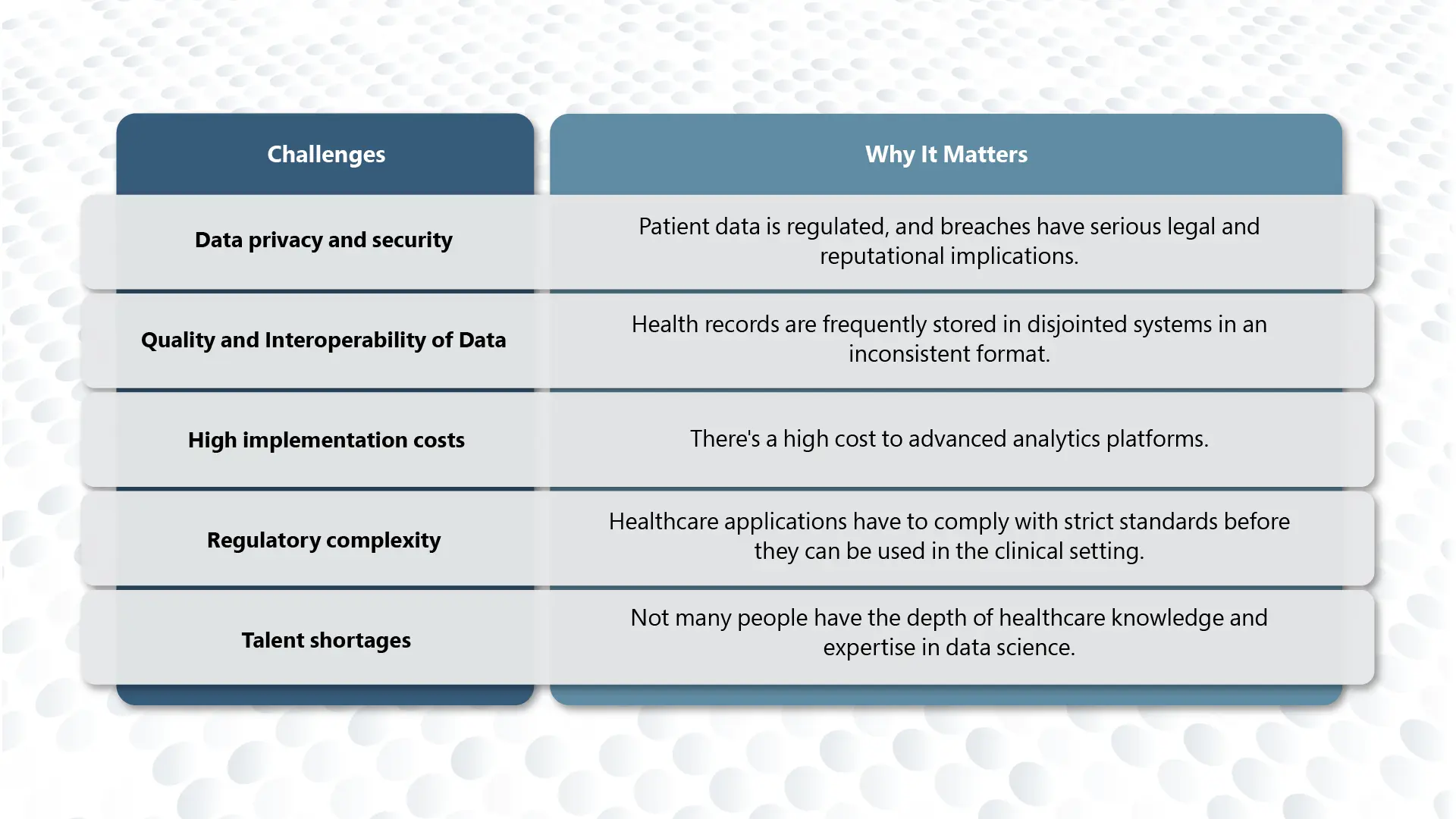
Challenges of Data Science in Healthcare
Despite its promise, healthcare data science faces real, persistent obstacles:
Future of Data Science in Healthcare
The trends in healthcare analytics are moving away from descriptive analytics and towards predictive and prescriptive analytics, which gives the ability to recommend a course of action instead of reporting what has already occurred.
The shift towards cloud-based platforms is driving the use to the norm, and generative AI is now starting to help with creating clinical documentation and summarizing research. As interoperability standards continue to evolve, the obstacles to sharing data across systems should become less of an issue, enabling more detailed analysis of a patient's entire care journey.
USDSI's Big Data Analytics in Healthcare resource explores these market insights, growth factors, and real-world applications in further detail.
>Top Data Science Skills for Healthcare Careers
Knowledge and expertise in health care data science requires a core set of skills that are also unique to the healthcare field, including statistical modelling, machine learning applied to health care data, understanding of health care data standards, and healthcare domain knowledge needed to make appropriate interpretations from results in a clinical context. USDSI's data science certifications help professionals build statistical, machine learning, and applied analytics skills, as an added advantage, with professional domain knowledge that all translate to work opportunities at hospital systems, health insurers, and biotechnology research organizations.
Conclusion
The shift toward predictive and prescriptive analytics, agentic AI, federated learning, and real-time monitoring points to where healthcare data science is headed next, with fewer isolated pilots and more embedded, continuous capability across the full patient journey.
Organizations and professionals that build this expertise deliberately now, rather than waiting for these trends to fully mature, are the ones positioned to act on them first. Data science has already moved from a peripheral tool to a central one in healthcare; what comes next is less about proving its value and more about how well organizations scale it responsibly.
FAQs
How long before a healthcare data science project shows measurable results?
It varies widely, though predictive analytics projects often show impact within 12 to 18 months.
Does wearable device data play a role alongside electronic health records?
Yes, increasingly, supplementing EHR data with real-time patient monitoring.
Is federated learning becoming more common for training models across hospitals?
Yes, it's gaining traction as a way to train models on distributed data without centralizing sensitive records.
This website uses cookies to enhance website functionalities and improve your online experience. By clicking Accept or continue browsing this website, you agree to our use of cookies as outlined in our privacy policy.