
Storage architecture in most enterprise IT environments was never built for what it is now being asked to handle. AI training pipelines, real-time analytics platforms, and expanding data residency requirements are all landing on infrastructure that was originally sized for far more predictable, transactional workloads.
IDC's Worldwide Quarterly Enterprise Storage Systems Tracker projects the global external OEM enterprise storage systems market will reach USD 41.09 billion for full-year 2026, a 16.3% increase driven by AI-related demand, deferred infrastructure refresh cycles, and rising component costs.
For IT teams running enterprise-scale environments, storage has stopped being a background procurement decision. It is now an architectural constraint that directly affects how fast AI initiatives can move and how reliably production systems hold up under load.
What is Data Storage Management?
Data storage management covers the technical practice of organizing, protecting, optimizing, and governing an organization's data across its full lifecycle, from ingestion and active use through archiving and eventual deletion.
Inside a modern enterprise IT stack, that means architectural decisions involving where data physically resides, how quickly it can be retrieved under production load, how it gets replicated for resilience, and how storage architecture itself stays compliant with regulatory frameworks that differ by region and industry.
Key Components of Data Storage Management
Every functioning enterprise storage strategy rests on the same core technical layers. Listed below are key components.
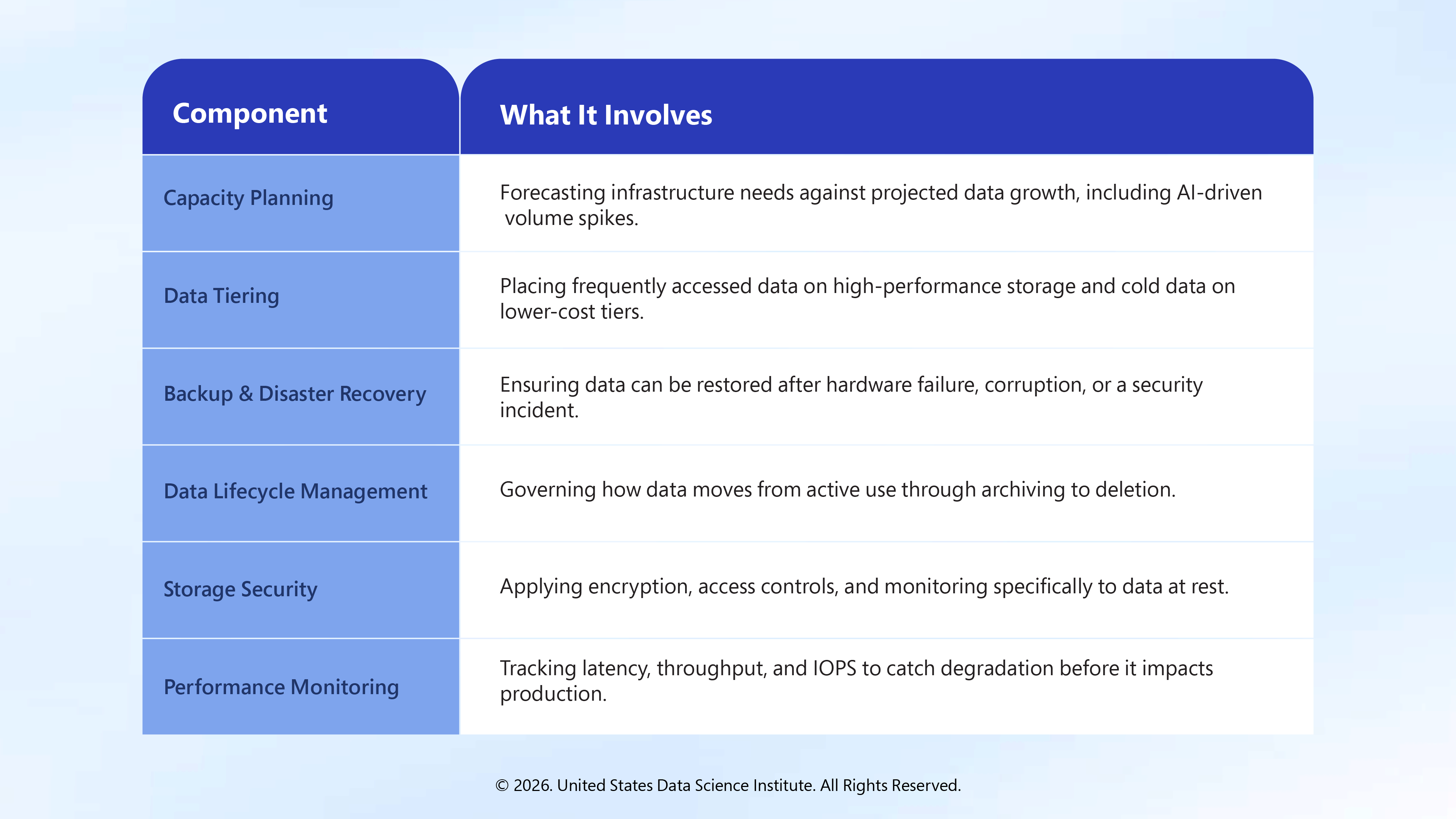
Enterprise Storage Architecture: How the Hardware and Software Layers Work Together in IT
A data storage system operates across two layers: hardware and software, as explained in detail below.
Hardware Layer
Storage arrays combine disks, SSDs, or hybrid tiers with controllers managing I/O requests, presenting data through three interface types:
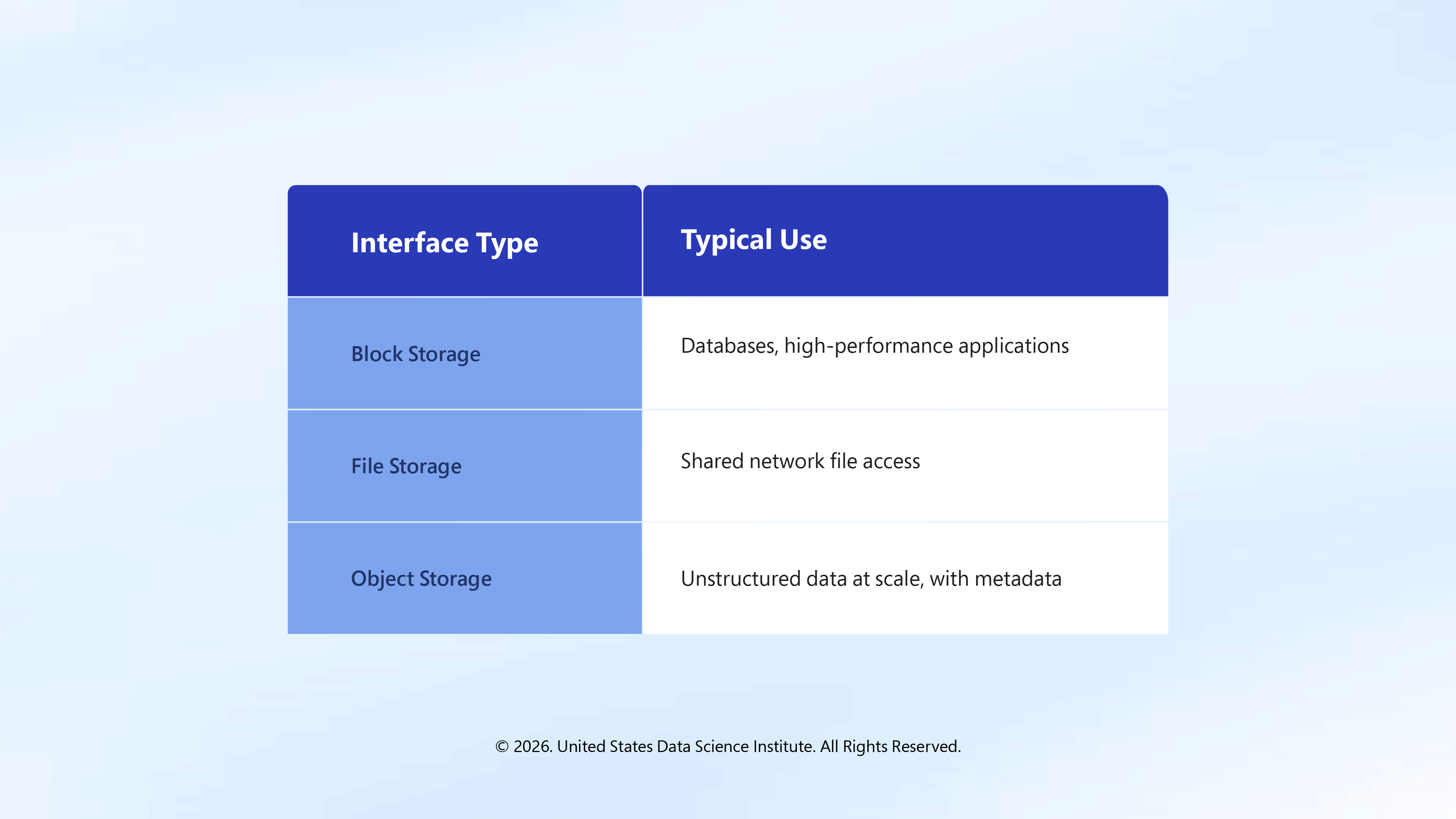
Protocol choice—Fibre Channel and iSCSI (block-level), NFS and SMB (file-level), or S3-compatible APIs (object-level)—directly affects latency, throughput, and scalability across enterprise IT environments.
Software Layer
Virtualization abstracts physical devices into logical volumes, enabling snapshots, replication, thin provisioning, and deduplication/compression, functions that keep enterprise storage resilient and space-efficient at scale.
Security Integration
Encryption at rest and in transit, MFA for administrators, audit logging, and predictive monitoring are built directly into the system, critical in enterprise IT where compliance and uptime carry real business consequences.
In short, a data storage system is not just disks; it is a managed service translating raw capacity into secure, scalable infrastructure that enterprise IT applications actually depend on.
Common Data Storage Challenges in Enterprise IT
IT teams running enterprise storage at scale run into a fairly consistent set of technical pressure points.
Key Strategies for Modern Data Storage Management
The IT teams managing this well tend to share a few consistent, deliberate technical practices as listed below.
That last point ties directly into DataOps, a discipline that applies continuous testing, monitoring, and automation to data pipelines the same way DevOps does for software delivery.
USDSI's insight on What DataOps means for data management breaks down how this approach extends specifically into storage strategy, treating stored data as a continuously validated system rather than a static archive sitting untouched between backups.
Building the Skills Behind Modern Data Storage Management
Managing enterprise storage well takes more than infrastructure knowledge alone; it requires understanding how storage architecture decisions ripple into data quality, governance, and downstream analytics performance. USDSI's data science certifications build cross-disciplinary expertise, covering the data architecture and infrastructure thinking needed to manage storage as part of a broader, AI-ready data strategy rather than treating it as an isolated IT function.
Conclusion
Enterprise data storage has moved past being background infrastructure. It is now a genuine architectural constraint, one that directly shapes how fast organizations can deploy AI and how reliably their systems perform under real production load. The IT teams extracting real value from their storage investment are the ones treating it as an ongoing technical discipline, tiering, automating, securing, and continuously optimizing, rather than a one-time infrastructure purchase revisited only after something breaks.
FAQs
What job roles focus on enterprise data storage management?
Storage Administrator, Storage Architect, and Cloud Infrastructure Engineer, typically within data engineering or infrastructure teams.
What are the main types of enterprise storage?
There are three main types, including block, file, and object. Enterprises can also use NAS, SAN, cloud storage, and hybrid storage environments depending on the workload, performance, access, and scalability needs.
What is driving the shift toward all-flash and higher-performance storage architectures?
Training pipelines and inference workloads need faster, more predictable read/write performance than older architectures were built to deliver.
This website uses cookies to enhance website functionalities and improve your online experience. By clicking Accept or continue browsing this website, you agree to our use of cookies as outlined in our privacy policy.